
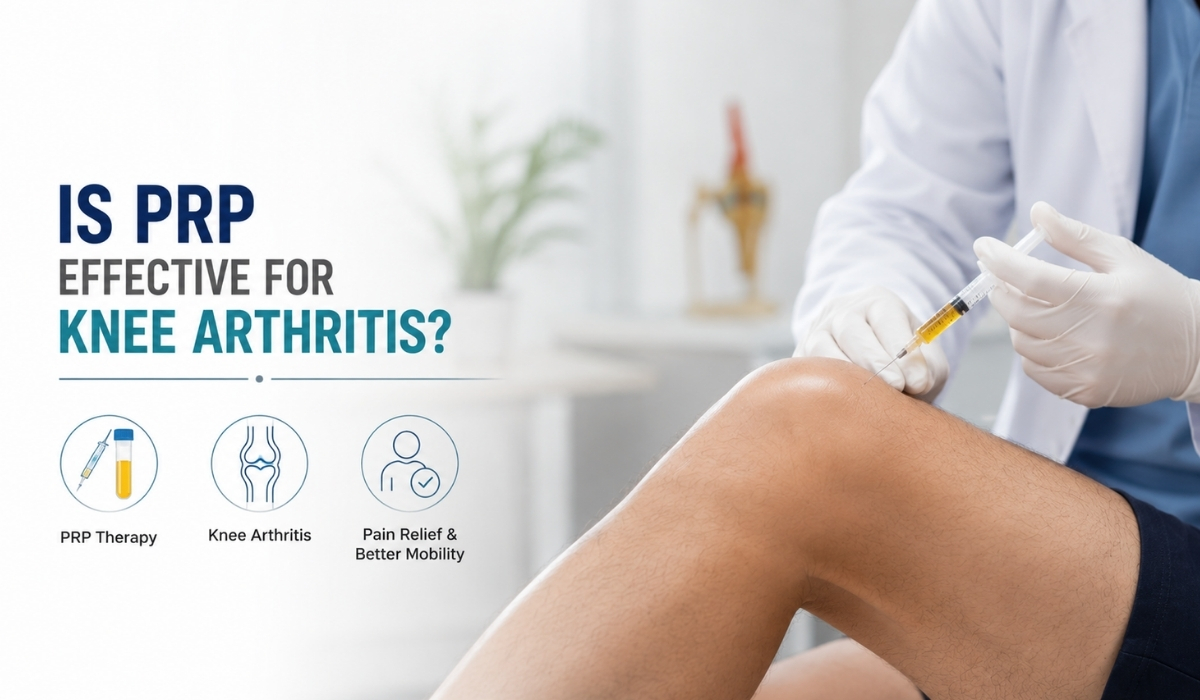

Quick Answer
| • Yes — for mild to moderate knee osteoarthritis (Kellgren-Lawrence grade I–III), current research shows PRP gives better and longer-lasting pain and function improvement than hyaluronic acid or corticosteroid injections. • PRP works best as an early-stage, symptom-management option — not a cure — and typically needs a series of 2–3 injections for the strongest results. • It is less effective in advanced, bone-on-bone arthritis, where structural support options are usually more appropriate. |
Quick Summary
- PRP uses concentrated platelets from your own blood to calm knee inflammation and support the joint’s healing response.
- 2024–2025 meta-analyses report PRP outperforming hyaluronic acid and corticosteroids for pain relief and function in knee osteoarthritis.
- Best results are seen in mild-to-moderate osteoarthritis; benefit drops in severe, bone-on-bone joints.
- A single injection helps some patients, but a series of 2–3 injections spaced a few weeks apart tends to work meaningfully better.
- Relief commonly lasts 6–12 months, and some patients report benefit up to 24 months.
- Major bodies such as the American College of Rheumatology and OARSI still stop short of formally endorsing PRP, mainly because preparation protocols vary so much between clinics.
- Higher BMI and a longer history of arthritis are linked to weaker results — earlier treatment tends to help more.
- PRP does not reverse advanced joint damage; it manages symptoms and may help delay other interventions.
Introduction
If you’ve been told PRP therapy could help your knee arthritis, you’ve probably also come across conflicting opinions — some call it a breakthrough, others call it overhyped. The honest answer sits in between. Platelet-rich plasma (PRP) is not a miracle cure, but a growing body of clinical research, including several 2024–2025 meta-analyses, shows it can meaningfully reduce knee arthritis pain and improve function for the right patient. This guide walks through what PRP actually is, what the evidence says about its effectiveness, who benefits most, and what to realistically expect from treatment.
What Is PRP Therapy?
Platelet-rich plasma is prepared by drawing a small sample of your own blood, spinning it in a centrifuge to concentrate the platelets, and injecting that concentrate directly into the knee joint under sterile, often ultrasound-guided, conditions. Platelets contain growth factors that play a role in tissue repair and modulating inflammation, which is the biological rationale for using PRP in osteoarthritic joints.
Because PRP is made from the patient’s own blood, it carries a low risk of allergic reaction, which is one reason it has become a widely used non-surgical option for knee pain over the last decade.
How PRP Works for an Arthritic Knee
Knee osteoarthritis involves progressive cartilage wear, low-grade joint inflammation, and changes in the joint fluid that normally cushions and lubricates movement. PRP is thought to work through two main mechanisms:
- Anti-inflammatory effect: growth factors and signalling proteins in platelets can help reduce inflammatory activity inside the joint, which is a major driver of arthritis pain.
- Supportive tissue response: PRP may help support the joint’s natural repair processes and improve the quality of joint fluid, though it does not regenerate lost cartilage in advanced disease.
Is PRP Effective for Knee Arthritis? What the Evidence Actually Shows
This is the question most patients really want answered, so here is a straightforward summary of where the research currently stands.
What multiple 2024–2025 studies agree on
- PRP — particularly leukocyte-poor PRP — shows superior pain relief and functional improvement compared with hyaluronic acid and corticosteroid injections, especially in mild-to-moderate osteoarthritis (Kellgren-Lawrence grades I–III).
- A large meta-analysis found the most significant improvement at the 6-month mark, with benefits considered clinically meaningful, not just statistically significant.
- A 2025 review comparing PRP to hyaluronic acid, corticosteroids, and bone marrow aspirate concentrate found PRP performs better than HA and steroids, and comparably to bone marrow concentrate.
- A course of injections works better than a single shot — one retrospective study found a series was roughly four times more effective for pain relief than one injection alone.
Where caution is still warranted
- Major professional bodies, including the American College of Rheumatology and OARSI, have not formally endorsed PRP for knee osteoarthritis, largely because PRP preparation protocols vary widely between clinics and studies, making outcomes harder to standardise and compare.
- Patients with a higher BMI or a longer-standing history of arthritis tend to see smaller benefits — earlier-stage treatment generally performs better.
- PRP is less effective in advanced, bone-on-bone osteoarthritis, where little cushioning cartilage remains.
| Expert Insight: At Nexus Pain, we treat PRP as a genuinely useful tool in the mild-to-moderate osteoarthritis stage — not as a universal fix. The patients who respond best are typically those who start treatment before the joint reaches advanced, bone-on-bone changes. |
PRP vs Hyaluronic Acid vs Corticosteroids
| Factor | PRP | Hyaluronic Acid | Corticosteroids |
| Pain relief duration | 6–12 months, sometimes up to 24 | Typically 3–6 months | Weeks to a few months |
| Best-suited stage | Mild to moderate OA | Mild to moderate OA | Short-term flare-ups |
| Mechanism | Anti-inflammatory + tissue support | Joint lubrication | Strong anti-inflammatory |
| Repeat use concern | Generally well tolerated | Well tolerated | Repeated use may affect cartilage over time |
| Evidence strength (2024–25) | Moderate, growing, favourable | Established but modest effect | Established, short-lived effect |
Who Is a Good Candidate for PRP?
PRP tends to work best for a fairly specific patient profile, and being upfront about this is part of setting realistic expectations.
- Diagnosed with mild-to-moderate knee osteoarthritis (Kellgren-Lawrence grade I–III)
- Wants to reduce reliance on repeated corticosteroid shots or delay surgery
- Has a reasonably active lifestyle and wants to preserve joint function
- Does not have an active infection, blood disorder, or certain cancers (screened during assessment)
Patients with advanced, bone-on-bone arthritis are usually better served by discussing structural or surgical options, since PRP has limited cartilage left to support at that stage.
The PRP Procedure: What to Expect
- A small blood sample is drawn, similar to a routine blood test.
- The sample is processed in a centrifuge to separate and concentrate the platelets.
- Under sterile technique — often with ultrasound guidance for accuracy — the concentrated PRP is injected into the knee joint.
- The full procedure typically takes 30–45 minutes, and most patients go home the same day.
- A course of 2–3 injections, spaced roughly 2–4 weeks apart, is a common protocol used to improve outcomes.
Recovery and What Happens After
Mild soreness, swelling, or stiffness at the injection site for one to three days is the most common after-effect — this is a normal part of the inflammatory response PRP relies on, not a complication. Most patients resume light daily activity within a day or two, while higher-impact activity is usually paced back in over one to two weeks, guided by your treating physician.
- Days 1–3: mild soreness/swelling is normal; ice and rest as advised
- Week 1–2: gradual return to daily activities
- Weeks 3–6: functional improvement often becomes noticeable
- Months 3–6: peak benefit typically reported in current research
Supporting Your Results: Lifestyle Factors That Matter
Because outcomes are linked to body weight and disease duration, a few supporting habits genuinely influence how well PRP performs.
- Maintaining a healthy body weight to reduce load on the knee joint
- Low-impact strengthening (physiotherapy-guided) to support joint stability
- Addressing knee pain early rather than waiting until arthritis has progressed
- Avoiding repeated high-impact stress on the joint during the healing window after injection
Expert Insight Sections
| Expert Insight 1: Patients often ask if PRP can “regrow” cartilage. It cannot reverse structural cartilage loss in advanced arthritis — its real value is calming inflammation and supporting joint function in the earlier stages of disease. |
| Expert Insight 2: The gap between a single injection and a full course (2–3 injections) is one of the most consistent findings in recent research — patients considering PRP should ask their clinic about a series-based protocol rather than a one-time shot. |
| Expert Insight 3: Not all PRP is prepared the same way. Platelet concentration and leukocyte content vary by clinic, and this variation is part of why professional bodies remain cautious — ask your provider how your PRP is prepared and processed. |
Common Mistakes Patients Make
- Expecting PRP to reverse advanced, bone-on-bone arthritis rather than manage early-to-moderate disease
- Choosing a single injection to save cost, then judging PRP as “ineffective” when a course was actually indicated
- Returning to high-impact activity too soon after injection instead of following a gradual, guided return
Myths vs Facts
| Myth | Fact |
| PRP cures knee arthritis permanently. | PRP manages symptoms and inflammation; it does not reverse underlying joint damage. |
| One PRP shot is enough for lasting results. | Research suggests a series of 2–3 injections generally outperforms a single injection. |
| PRP works the same at every clinic. | Preparation protocols (platelet and leukocyte content) vary and directly affect outcomes. |
| PRP is only for athletes. | It is used across age groups, most commonly for adults with mild-to-moderate osteoarthritis. |
Questions Patients Forget to Ask
- What grade is my knee osteoarthritis, and does that make me a good PRP candidate?
- How is your clinic’s PRP prepared — platelet-rich, leukocyte-poor, or leukocyte-rich?
- Will I need a single injection or a course, and how is that decided?
- What realistic improvement, in pain and function, can I expect by month three and month six?
- What happens if PRP doesn’t give me enough relief — what’s the next step?
Practical Action Plan
- Get an accurate diagnosis and osteoarthritis grading (clinical exam plus imaging) before considering PRP.
- Discuss whether your stage of arthritis fits the profile that responds best to PRP.
- Ask about the clinic’s PRP preparation protocol and whether a single injection or a course is recommended for your case.
- Set a realistic 3–6 month timeline to judge results, rather than expecting immediate change.
- Pair treatment with weight management and guided low-impact strengthening for better odds of a good outcome.
Nexus Pain Expert Summary Box
| Nexus Pain’s Perspective: PRP is one option within a broader non-surgical pain management plan, not a stand-alone fix. At Nexus Pain Management, PRP is considered after a full assessment of your osteoarthritis stage, alongside physiotherapy, activity modification, and — where appropriate — other interventional options, so the treatment plan matches the actual condition of your knee rather than a one-size-fits-all protocol. |
Key Takeaways
- PRP has moderate, growing evidence supporting its effectiveness for mild-to-moderate knee osteoarthritis.
- It generally outperforms hyaluronic acid and corticosteroids for pain relief duration and functional improvement.
- A course of injections tends to outperform a single injection.
- Results are weaker in advanced, bone-on-bone arthritis and in patients with higher BMI or long-standing disease.
- Major medical bodies remain cautious due to inconsistent preparation protocols across providers.
- PRP works best as part of a broader, personalised pain management plan — not a stand-alone cure.
How Nexus Pain Can Help
Nexus Pain Management approaches knee arthritis with a comprehensive pain assessment before recommending any treatment, including PRP. This includes evidence-based, personalised treatment planning, non-surgical pain management options, and — where clinically appropriate — interventional pain procedures. The focus throughout is on realistic, long-term pain relief strategies, rehabilitation guidance, and lifestyle modification support, so each treatment plan reflects the actual stage and needs of the patient’s knee, not a generic protocol.
Frequently Asked Questions
1. Is PRP actually effective for knee arthritis?
For mild-to-moderate knee osteoarthritis, current research shows PRP can offer meaningful pain relief and functional improvement, generally outperforming hyaluronic acid and corticosteroid injections in recent studies.
2. How many PRP injections do I need for knee arthritis?
A course of 2–3 injections spaced a few weeks apart is a common protocol and tends to produce better results than a single injection.
3. How long does PRP relief last?
Many patients report benefit for 6–12 months, with some studies noting improvement lasting up to 24 months, particularly in earlier-stage arthritis.
4. Does PRP regrow cartilage?
No. PRP supports the joint’s inflammatory and healing environment but does not regenerate lost cartilage in advanced osteoarthritis.
5. Is PRP better than a knee replacement?
They serve different purposes. PRP is a non-surgical option for mild-to-moderate arthritis aimed at managing symptoms, while knee replacement is generally reserved for advanced, severely damaged joints.
6. Who should not get PRP for knee arthritis?
Patients with advanced bone-on-bone arthritis, active infections, certain blood disorders, or specific cancers are typically not ideal candidates — a clinical assessment determines suitability.
7. Is PRP painful?
The injection itself involves a brief needle stick; mild soreness or swelling for one to three days afterward is common and expected.
8. How is PRP different from a corticosteroid injection?
Corticosteroids reduce inflammation quickly but the relief is usually shorter-lived and repeated use may affect cartilage over time, whereas PRP tends to offer longer-lasting benefit with a more gradual onset.
9. What does PRP for knee arthritis cost in Ahmedabad?
Cost varies by clinic and by whether a single injection or a full course is recommended; your treating physician can provide an accurate estimate after assessing your knee.
10. Can PRP delay the need for knee surgery?
In appropriately selected, mild-to-moderate cases, PRP may help manage symptoms well enough to delay surgical intervention, though it is not a guaranteed substitute for surgery in advanced disease.
11. Is PRP safe?
Because PRP is prepared from your own blood, the risk of allergic reaction is low, and the most common side effect is short-term soreness or swelling at the injection site.
12. Where can I get PRP therapy for knee arthritis in Ahmedabad?
Nexus Pain Management, based in Ahmedabad, offers PRP as part of a comprehensive non-surgical pain management evaluation for suitable candidates.