

Quick Answer
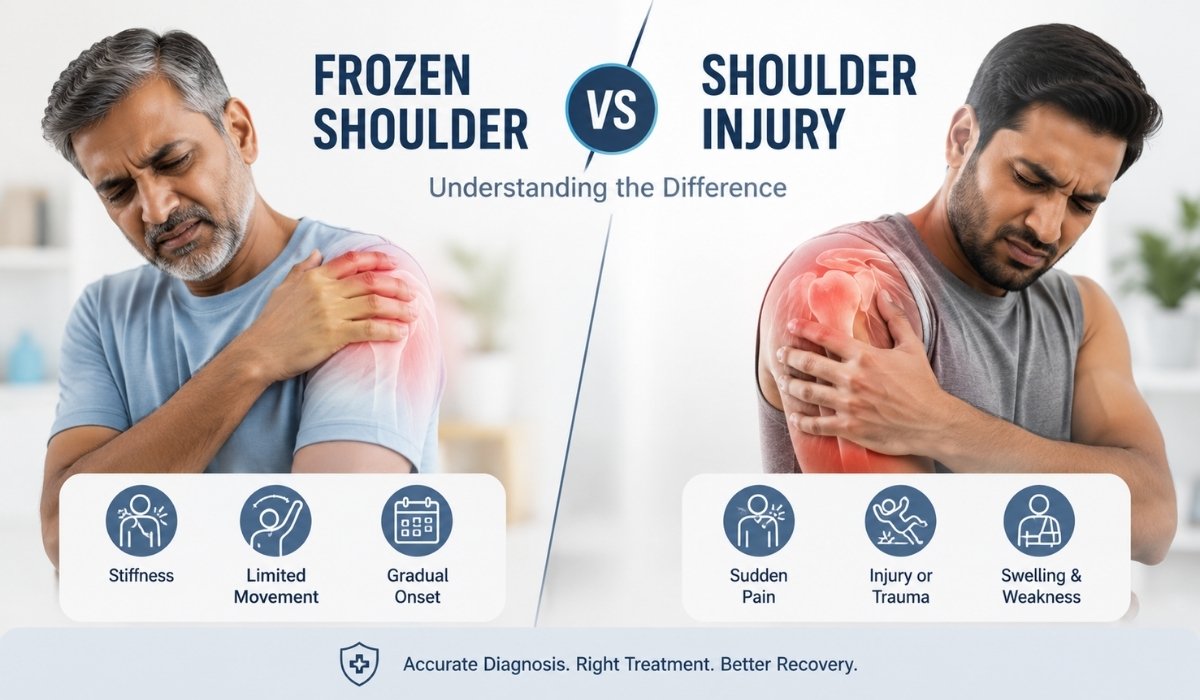
| Frozen shoulder (adhesive capsulitis) is a stiffening and thickening of the shoulder joint capsule that restricts movement in every direction, including when someone else moves your arm for you. A shoulder injury — such as a rotator cuff tear, impingement, or strain — is damage to a specific muscle, tendon, or structure that usually causes pain and weakness with active movement, while passive movement (someone else lifting your arm) is often still possible. The passive range-of-motion test is the single biggest clue that separates the two. |
Quick Summary
- Frozen shoulder restricts movement in all directions, even with assistance; most shoulder injuries allow more passive movement than active movement.
- Frozen shoulder usually develops gradually over weeks to months; injuries like rotator cuff tears can happen suddenly from a fall or lifting strain, or build up over years of overuse.
- Frozen shoulder affects roughly 2–5% of the general population and is more common between ages 40–60, particularly in women and people with diabetes.
- A rotator cuff tear can cause sharp pain and noticeable weakness, especially when raising the arm overhead; frozen shoulder pain is typically deep, diffuse, and worse at night.
- Frozen shoulder progresses through three stages — freezing, frozen, and thawing — that can span months to a couple of years.
- Imaging (ultrasound or MRI) helps confirm a structural injury and can also identify capsular thickening consistent with frozen shoulder.
- Frozen shoulder is overwhelmingly managed without surgery, while some rotator cuff tears may eventually need surgical repair if conservative care fails.
Introduction
Shoulder pain is one of the most common reasons people in Ahmedabad visit a pain management clinic, and one of the most common points of confusion is whether the problem is a frozen shoulder or an underlying shoulder injury. Both can cause pain, stiffness, and difficulty sleeping on the affected side, but the underlying mechanism, expected recovery path, and treatment approach are quite different. Getting the distinction right early matters — treating a rotator cuff tear like a frozen shoulder, or vice versa, can delay real recovery by months.
This guide breaks down how frozen shoulder and shoulder injuries differ in symptoms, causes, diagnosis, and treatment, so you know what questions to ask before your consultation.
What Is Frozen Shoulder?
Frozen shoulder, medically known as adhesive capsulitis, occurs when the capsule of connective tissue surrounding the shoulder joint becomes inflamed, thickens, and tightens. This shrinks the space available for the joint to move, restricting motion in every direction — forward, backward, and sideways — regardless of whether the movement is active (done by the patient) or passive (assisted by someone else).
Expert Insight: In clinical practice, frozen shoulder is often missed in its early “freezing” stage because pain, not stiffness, is the dominant complaint at first. Patients frequently assume it’s a muscle strain and delay assessment until motion loss becomes obvious — by which point the stiffer “frozen” stage has already set in.
What Is a Shoulder Injury?
“Shoulder injury” is a broad term covering damage to a specific structure in the shoulder — most often the rotator cuff tendons, but also the labrum, bursa, or surrounding muscles. Common types include rotator cuff tears (partial or complete), shoulder impingement, tendinitis, and bursitis. Injuries can be acute (a fall, a heavy lift, a sports collision) or degenerative (built up gradually from repetitive overhead work, age-related wear, or occupations like painting, carpentry, or racquet sports).
Unlike frozen shoulder, most shoulder injuries leave passive range of motion relatively intact — a clinician or family member can often lift the arm through most of its normal arc, even though the patient cannot do it unassisted due to pain or weakness.
Symptoms: How to Tell Them Apart
The clearest bedside clue is the passive range-of-motion test: if someone else can lift your arm for you through a near-normal arc, an injury such as a rotator cuff tear is more likely. If the shoulder feels physically “locked” even with assistance, frozen shoulder is more likely.
| Feature | Frozen Shoulder | Shoulder Injury (e.g. Rotator Cuff Tear) |
| Onset | Gradual, over weeks to months | Often sudden (fall, lift) or gradual overuse |
| Passive motion | Restricted even with assistance | Often preserved with assistance |
| Pain character | Deep, diffuse ache, worse at night | Sharp pain, often with specific movements |
| Weakness | Uncommon as a primary symptom | Common, especially lifting overhead |
| Progression | Three stages over months to ~2 years | Varies; can worsen without treatment |
| Typical age group | 40–60 years, more common in women | Any age; higher in athletes and manual workers |
Causes
Frozen shoulder causes include:
- Idiopathic onset (no clear trigger) — the most common pattern
- Prolonged immobilization after a prior injury, fracture, or surgery
- Diabetes and thyroid disorders, which significantly raise risk
- Underlying shoulder inflammation left untreated
Shoulder injury causes include:
- Acute trauma — a fall onto an outstretched arm, sudden heavy lifting, or a sports collision
- Repetitive overhead motion — swimming, painting, racquet sports, manual labour
- Age-related degeneration of tendon tissue, which raises tear risk after the mid-40s
- Poor posture and muscle imbalance contributing to impingement
Risk Factors
- Age 40–60 (frozen shoulder); any age with repetitive strain (injuries)
- Diabetes, thyroid disease, or cardiac conditions (frozen shoulder)
- Recent shoulder or arm surgery, stroke, or a period of arm immobilisation
- Occupations or sports requiring repetitive overhead arm movement
- Previous shoulder injury that was not fully rehabilitated
Diagnosis
A thorough clinical examination is usually the starting point — comparing active versus passive range of motion, checking for specific weakness patterns, and reviewing how the pain began. Imaging plays a confirming role: an MRI or ultrasound can rule out or confirm a structural tear, and can occasionally show the capsular thickening characteristic of frozen shoulder. X-rays are sometimes used to rule out arthritis or bone spurs contributing to impingement.
Common Mistake: Self-diagnosing based on pain location alone. Pain in the same general area of the shoulder can come from the capsule, the tendons, the bursa, or even referred pain from the neck — a proper assessment is what actually separates these conditions.
Treatment Options
Treatment approaches diverge meaningfully once a diagnosis is confirmed.
| Frozen Shoulder | Shoulder Injury |
| Physiotherapy focused on gentle, progressive stretching | Physiotherapy focused on strengthening and controlled loading |
| Anti-inflammatory pain management | Anti-inflammatory pain management |
| Corticosteroid or hydrodilatation injections in select cases | Targeted injections or PRP therapy for tendon healing |
| Radiofrequency ablation for select chronic pain cases | Radiofrequency ablation for select chronic pain cases |
| Surgery rarely needed | Surgery considered if conservative care fails or tear is complete |
Non-Surgical Treatment Approaches
Most frozen shoulder cases, and a large share of shoulder injuries, respond well to non-surgical, interventional pain management. Structured physiotherapy, targeted injections, and image-guided procedures such as radiofrequency ablation or PRP therapy can meaningfully reduce pain and restore function without the recovery time associated with surgery. The right combination depends on the specific diagnosis, severity, and how long symptoms have been present.
Expert Insight: The earlier a frozen shoulder is correctly identified, the more responsive it tends to be to conservative treatment. Waiting through the freezing stage without intervention often means a longer, stiffer frozen stage before recovery begins.
Prevention Tips
- Keep the shoulder moving through its normal range even after a minor injury — avoid unnecessary prolonged immobilisation
- Manage diabetes and thyroid conditions proactively, as these directly raise frozen shoulder risk
- Warm up before overhead activity and build shoulder and rotator cuff strength gradually
- Seek assessment for shoulder pain that persists beyond 2–3 weeks rather than waiting it out
- Complete any prescribed physiotherapy fully, even once pain improves, to avoid re-injury or stiffness
Recovery and Rehabilitation
Frozen shoulder recovery is typically the slower of the two, often spanning several months to around two years across its freezing, frozen, and thawing stages, though most patients see steady improvement with consistent physiotherapy. Shoulder injury recovery timelines vary more widely — mild strains and tendinitis often improve within 4–8 weeks of guided rehabilitation, while a significant rotator cuff tear, if treated conservatively, may take 3–6 months to regain full strength, and longer if surgery is required.
Common Mistake: Stopping rehabilitation exercises as soon as pain eases. Pain relief is not the same as full recovery — stopping early is one of the most frequent reasons stiffness or weakness returns.
Expert Insight: When Both Conditions Overlap
It is possible to have a rotator cuff injury and later develop frozen shoulder, particularly if the arm was kept still for an extended period during recovery. This is why ongoing follow-up matters even after an initial injury has been treated.
Common Mistakes Patients Make
- Assuming all shoulder pain is “just a strain” and delaying evaluation for months
- Relying only on painkillers without addressing the underlying stiffness or structural cause
- Over-resting the shoulder for frozen shoulder, which can worsen stiffness rather than help it
Myths vs Facts
| Myth | Fact |
| Frozen shoulder always needs surgery. | Most cases improve with physiotherapy and non-surgical pain management; surgery is uncommon. |
| If you can move your arm at all, it can’t be frozen shoulder. | Some limited active movement is still possible, especially in early stages; the key marker is restricted passive movement. |
| Rest is always best for shoulder pain. | Complete immobilisation can worsen or trigger frozen shoulder; guided, gentle movement is usually recommended instead. |
| A rotator cuff tear always requires surgery. | Many tears, especially partial ones, respond well to physiotherapy and interventional treatment first. |
Questions Patients Forget to Ask
- Is my shoulder pain coming from the joint capsule, a tendon, or somewhere else, like my neck?
- What stage is my frozen shoulder in, and how does that change my treatment plan?
- Will imaging actually change my treatment, or is a clinical exam enough for now?
- What specific home exercises are safe for my exact diagnosis, and which should I avoid?
- At what point would we consider an injection, PRP, or radiofrequency ablation instead of continuing physiotherapy alone?
Practical Action Plan
- If shoulder pain or stiffness has lasted more than 2–3 weeks, book a clinical assessment rather than waiting it out.
- Note whether someone else can lift your arm for you comfortably — this detail helps guide the initial diagnosis.
- Avoid prolonged immobilisation; keep the shoulder gently mobile unless specifically advised otherwise.
- Ask your clinician whether imaging is needed to confirm a structural injury or capsular thickening.
- Follow the full physiotherapy course prescribed, even after pain starts improving.
- Discuss non-surgical options — physiotherapy, injections, PRP, or radiofrequency ablation — before considering surgery.
Nexus Pain Expert Summary Box
| Distinguishing frozen shoulder from a shoulder injury starts with a comprehensive pain assessment that looks at active versus passive movement, pain pattern, and relevant risk factors such as diabetes or a prior injury. Based on that assessment, an evidence-based, personalised treatment plan can combine physiotherapy guidance, non-surgical interventional pain procedures, and long-term rehabilitation support — with the goal of restoring shoulder function without unnecessary surgery wherever possible. Lifestyle and movement guidance is also provided to reduce the chance of recurrence. |
Key Takeaways
- Frozen shoulder restricts both active and passive movement; most injuries mainly limit active movement.
- Onset is gradual for frozen shoulder, often sudden for acute injuries like tears.
- Diabetes, thyroid conditions, and prior immobilisation raise frozen shoulder risk.
- A proper clinical exam, and imaging when needed, is the reliable way to tell the two apart.
- Both conditions usually respond to non-surgical, physiotherapy-led treatment when caught early.
- Delaying assessment tends to prolong recovery for either condition.
- Recovery timelines differ significantly, so an accurate diagnosis sets realistic expectations.
Frequently Asked Questions
- What is the main difference between frozen shoulder and a shoulder injury?
Frozen shoulder restricts movement in every direction, even when someone else moves your arm for you, because the joint capsule itself has tightened. A shoulder injury, such as a rotator cuff tear, usually still allows passive movement even when active movement is painful or weak.
- Can a shoulder injury turn into frozen shoulder?
Yes. Prolonged immobilisation after an injury or surgery is a recognised risk factor for developing frozen shoulder afterward, which is why gentle, guided movement during recovery matters.
- How long does frozen shoulder usually last?
Frozen shoulder typically progresses through freezing, frozen, and thawing stages over several months to around two years, though consistent physiotherapy can support steadier improvement.
- Is frozen shoulder more common in people with diabetes?
Yes, diabetes is a well-established risk factor for frozen shoulder, along with thyroid disorders and periods of shoulder immobilisation.
- Does a rotator cuff tear always need surgery?
Not always. Many tears, particularly partial ones, are managed successfully with physiotherapy and non-surgical pain management before surgery is considered.
- What does the “passive range of motion” test actually check?
It checks whether someone else can move your arm through its normal range for you. Preserved passive motion points more toward an injury like a tear; restricted passive motion points more toward frozen shoulder.
- Can I have both a rotator cuff injury and frozen shoulder at the same time?
Yes, this combination does occur, which is one reason accurate clinical assessment is important rather than assuming just one condition is present.
- Is shoulder pain that’s worse at night more typical of frozen shoulder or an injury?
Night pain is common in both, but the deep, diffuse ache of frozen shoulder disrupting sleep is a classic pattern, while injury-related night pain often relates to specific sleeping positions that load the tendon.
- What tests are used to diagnose frozen shoulder versus a shoulder injury?
A clinical exam comparing active and passive movement is the starting point; ultrasound or MRI can then confirm a structural tear or show capsular thickening if the diagnosis remains unclear.
- Is exercise safe for frozen shoulder, or should the shoulder be rested?
Gentle, guided movement is generally recommended over complete rest, since prolonged immobilisation can worsen stiffness. Exercises should be tailored to your specific stage and diagnosis.
- When should I see a pain management specialist for shoulder pain?
If shoulder pain or stiffness has persisted beyond 2–3 weeks, is limiting daily activities, or is affecting sleep, it’s worth getting a clinical assessment rather than waiting for it to resolve on its own.
- Where can I get frozen shoulder or shoulder injury treatment in Ahmedabad?
Nexus Pain Management in Ahmedabad offers comprehensive shoulder pain assessment and evidence-based, non-surgical treatment planning, including physiotherapy guidance and interventional pain procedures where appropriate.