

Quick Answer
Vertebroplasty is generally recommended for patients with a painful vertebral compression fracture — most often caused by osteoporosis, and sometimes by cancer or trauma — when pain has not improved after 4–6 weeks of conservative treatment, or when pain is severe enough to limit mobility, breathing, or independence. It is not typically the first option; it is considered when conservative care has failed or is unlikely to succeed.
Quick Summary
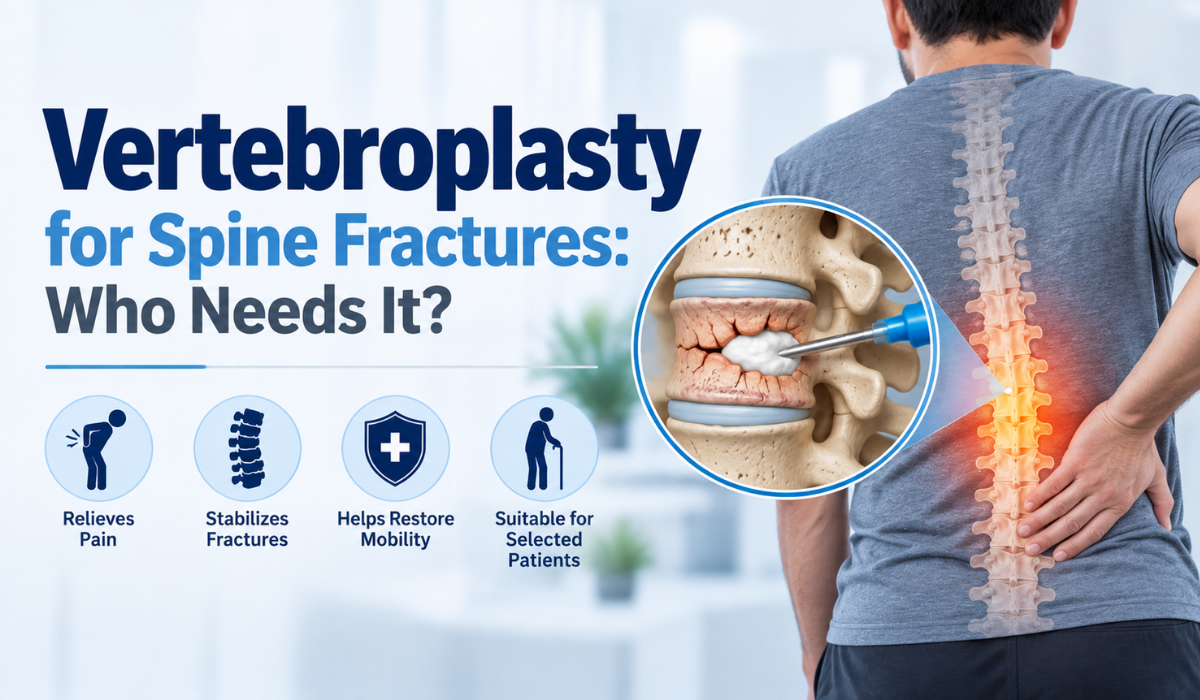
● Vertebroplasty stabilizes a fractured vertebra by injecting medical-grade bone cement into it.
● Most candidates are patients with osteoporotic compression fractures that haven’t responded to 4–6 weeks of conservative care.
● It is also used for fractures caused by cancer (metastatic disease) or, less commonly, trauma.
● The procedure is minimally invasive, done under local anaesthesia with sedation or light general anaesthesia, and usually takes 30–60 minutes per level.
● Most patients report meaningful pain relief within 24–72 hours.
● Not every fracture qualifies — some heal well with bracing, medication, and physiotherapy alone.
● Kyphoplasty is a related option that uses a balloon to restore vertebral height before cement injection.
Introduction
A vertebral compression fracture can turn ordinary movements — bending to pick up a bag, coughing, even standing up from a chair — into a source of sharp, disabling back pain. For many patients, especially older adults with osteoporosis, this is often the first sign that something is wrong. The natural question that follows a diagnosis is straightforward: does this need vertebroplasty, or will it heal on its own? The honest answer is that it depends on how the fracture behaves over the following weeks, not just on the X-ray or MRI report. This guide walks through exactly who tends to benefit from vertebroplasty, who doesn’t, and what the decision-making process actually looks like.
What Is a Vertebral Compression Fracture?
A vertebral compression fracture happens when a vertebra — one of the bones stacked to form the spine — collapses or loses height, usually because the bone has become too weak to bear normal load. The thoracic and lower lumbar spine are affected most often. Unlike fractures from a single dramatic injury, many compression fractures in older adults happen during ordinary activity, which is why they’re sometimes missed for weeks.
Symptoms
- Sudden onset of localized mid-back or lower-back pain, often after a minor movement
- Pain that worsens with standing, walking, or changing position, and eases when lying flat
- Reduced height or a stooped, forward-leaning posture (kyphosis) if fractures accumulate over time
- Pain aggravated by coughing, sneezing, or laughing
- Difficulty performing daily tasks like bending, dressing, or getting out of bed
Causes and Risk Factors
Osteoporosis is by far the leading cause, particularly in postmenopausal women and older men with low bone density. Cancer that has spread to the spine (metastatic disease) and, less commonly, trauma from a fall or accident are the other two major categories.
- Age over 65, particularly postmenopausal women
- Diagnosed or undiagnosed osteoporosis or osteopenia
- Long-term steroid use
- History of cancer with spread to bone
- Prior compression fractures (each fracture roughly doubles the risk of another)
- Low body weight, smoking, and sedentary lifestyle
Diagnosis
Diagnosis typically starts with an X-ray to confirm the fracture, followed by an MRI to check whether the fracture is recent (acute) or old (chronic) and to rule out nerve involvement. A DEXA scan is often ordered to assess bone density and identify underlying osteoporosis. This distinction between acute and chronic fractures matters enormously — vertebroplasty is generally most effective for fractures that are still acute or subacute, typically within about 8–12 weeks of onset.
Who Needs Vertebroplasty? Candidacy Criteria
Vertebroplasty is not a default treatment for every fracture. It tends to be recommended when several of the following apply:
- Pain persists at a moderate-to-severe level after 4–6 weeks of conservative treatment (rest, bracing, pain medication, physiotherapy)
- The fracture is confirmed as acute or subacute on MRI, with bone marrow oedema indicating it is still ‘active’
- Pain significantly limits mobility, independence, or the ability to breathe deeply (common with thoracic fractures)
- The patient is not a good candidate for prolonged bed rest — for example, older adults at risk of pneumonia, blood clots, or muscle deconditioning
- The fracture is due to osteoporosis or a stable, well-controlled malignancy, without active infection at the fracture site
| Expert Insight — Why Timing Matters ● At Nexus Advanced Pain Management, one of the most common patient questions is: ‘Should we wait and see?’ A short trial of conservative care is reasonable and often appropriate. But waiting too long — beyond 8–12 weeks — can reduce how well vertebroplasty works, because the fracture may begin healing in a collapsed position, and prolonged immobility itself raises the risk of complications like deep vein thrombosis and further bone loss. The decision window matters as much as the decision itself. |
Who Should NOT Have Vertebroplasty
- Fractures that are already well-healed (chronic) and no longer painful
- Active infection at the fracture site or in the bloodstream
- Uncorrected bleeding disorders
- Fracture fragments already causing spinal cord or nerve compression, which usually needs surgical decompression instead
- Patients whose pain is improving steadily on conservative care alone
Non-Surgical (Conservative) Treatment First
For many patients, conservative management is tried first and works well. This typically includes short-term rest, a supportive back brace, targeted pain medication, and gentle physiotherapy once pain allows. Bone-strengthening medication for osteoporosis is usually started at this stage as well, since preventing the next fracture is just as important as treating the current one.
How Vertebroplasty Is Performed
Vertebroplasty is done as a minimally invasive, image-guided procedure. Under local anaesthesia with sedation, a thin needle is guided into the fractured vertebra using real-time X-ray imaging (fluoroscopy). Medical-grade bone cement (PMMA) is then injected to stabilize the bone from the inside. The procedure generally takes 30–60 minutes per vertebral level, and most patients go home the same day or after a short overnight observation.
Vertebroplasty vs Kyphoplasty vs Conservative Management
| Factor | Vertebroplasty | Kyphoplasty | Conservative Management |
| Invasiveness | Minimally invasive, needle-based | Minimally invasive, uses a balloon before cement | Non-invasive |
| Height restoration | Limited | Better height/deformity correction | None — relies on natural healing |
| Pain relief onset | 24–72 hours | 24–72 hours | Weeks to months |
| Best suited for | Acute painful fracture, failed conservative care | Fractures with notable height loss/deformity | Mild fractures, early-stage pain |
| Recovery time | 1–2 days | 1–2 days | 6–12 weeks |
Recovery and Rehabilitation
Most patients notice significant pain relief within one to three days. Walking is usually encouraged the same day or the next, since movement helps prevent deconditioning. A brace may be used for a short period for comfort, and physiotherapy is introduced gradually to rebuild core and back strength. Because vertebroplasty stabilizes the fracture but doesn’t treat the underlying cause, ongoing osteoporosis management — medication, calcium and vitamin D, and fall-prevention strategies — remains essential afterward.
| Expert Insight — Recovery Isn’t the Finish Line ● A pain-free patient two days after vertebroplasty sometimes assumes the underlying problem is solved. It isn’t. The cement stabilizes one vertebra; it does nothing for bone density elsewhere in the spine. Without a bone-health plan, the risk of a fracture in an adjacent vertebra remains real. We treat the procedure and the osteoporosis management plan as two halves of the same treatment, not separate issues. |
Risks and Complications
Vertebroplasty is generally considered safe, with serious complications being uncommon. Reported risks include cement leakage outside the vertebra (usually without symptoms, but occasionally requiring monitoring), infection, bleeding, temporary nerve irritation, and, rarely, a fracture in an adjacent vertebra related to the underlying osteoporosis rather than the procedure itself. Discussing individual risk factors — bone quality, fracture location, and overall health — with a specialist beforehand helps set realistic expectations.
Prevention Tips
- Get a DEXA bone density scan if you’re over 50, especially post-menopause
- Ensure adequate calcium and vitamin D intake, and discuss bone-strengthening medication if osteoporosis is diagnosed
- Incorporate weight-bearing and balance exercises to reduce fall risk
- Address home fall hazards — loose rugs, poor lighting, unstable footwear
- Avoid smoking and limit alcohol, both of which weaken bone
Common Mistakes Patients Make
- Waiting too long — pushing conservative care past 8–12 weeks when pain isn’t improving, reducing the eventual effectiveness of vertebroplasty
- Treating the fracture in isolation and ignoring the underlying osteoporosis, which raises the risk of a new fracture
- Assuming all back pain after a fall is muscular and skipping imaging, delaying an accurate diagnosis
Myths vs Facts
| Myth | Fact |
| “Vertebroplasty is major spine surgery.” | It is a minimally invasive, needle-based procedure, not open surgery, with a same-day or overnight recovery in most cases. |
| “Every spine fracture needs vertebroplasty.” | Many fractures heal well with bracing, medication, and physiotherapy alone; the procedure is reserved for specific situations. |
| “Once the cement is in, the spine problem is solved.” | Vertebroplasty stabilizes the fractured vertebra, but ongoing bone-density management is still needed to prevent future fractures. |
| “Pain relief takes weeks after the procedure.” | Most patients notice meaningful relief within 24–72 hours. |
Questions Patients Forget to Ask
- How will you confirm my fracture is still acute and likely to respond to vertebroplasty?
- What is being done about the underlying cause (osteoporosis or cancer) alongside this procedure?
- What does the recovery and physiotherapy plan look like in the first six weeks?
- What are the specific risks in my case, given my bone quality and overall health?
- If this vertebra is treated, what is being done to lower the risk of the next one fracturing?
Practical Action Plan
- See a pain specialist or spine specialist promptly after a suspected fracture rather than waiting out the pain at home
- Get an MRI to confirm whether the fracture is acute, and a DEXA scan to assess bone density
- Try a structured 4–6 week course of conservative care unless pain is severe or disabling
- If pain hasn’t meaningfully improved by 4–6 weeks, discuss vertebroplasty candidacy with your specialist
- Start or continue osteoporosis treatment regardless of which path is chosen for the fracture itself
Nexus Pain Expert Summary
| Vertebroplasty is best understood as a targeted tool for a specific situation: a painful, still-acute vertebral compression fracture that hasn’t responded to a reasonable trial of conservative care. It is not the first step for every fracture, and it is not a substitute for treating the underlying bone health issue. The right decision depends on imaging findings, how long the pain has persisted, and the patient’s overall health — which is why an individualized assessment matters more than a one-size-fits-all rule. |
How Nexus Pain Can Help
Nexus Advanced Pain Management provides comprehensive assessment for patients with vertebral compression fractures, including imaging review and evidence-based treatment planning. Our approach combines interventional options — including Vertebroplasty and Radiofrequency Ablation — with structured conservative care, personalized treatment planning, and long-term guidance on bone health and rehabilitation, so that both the fracture and its underlying cause are addressed.
Key Takeaways
- Vertebroplasty stabilizes a painful, acute vertebral compression fracture using bone cement
- It is usually considered after 4–6 weeks of conservative treatment hasn’t worked
- Osteoporosis is the leading underlying cause and needs its own treatment plan
- Timing matters — fractures older than 8–12 weeks may respond less well
- Most patients feel significant pain relief within 24–72 hours
- Kyphoplasty is a related option better suited when height restoration is a priority
- Recovery is quick, but ongoing bone-health management is essential to prevent future fractures
- Not everyone is a candidate — infection, healed fractures, and nerve compression change the approach
FAQ Section
What is vertebroplasty?
Vertebroplasty is a minimally invasive procedure in which medical-grade bone cement is injected into a fractured vertebra to stabilize it and relieve pain.
Who needs vertebroplasty for a spine fracture?
Patients with a painful, acute vertebral compression fracture that hasn’t improved after 4–6 weeks of conservative treatment, or whose pain severely limits mobility or breathing, are typically considered candidates.
Is vertebroplasty painful?
The procedure is performed under local anaesthesia with sedation, so discomfort during the procedure is minimal. Most patients feel reduced pain, not increased pain, within a day or two afterward.
How long does vertebroplasty recovery take?
Most patients go home the same day or after overnight observation and can resume light activity within a day or two, with fuller recovery over one to two weeks.
What is the difference between vertebroplasty and kyphoplasty?
Kyphoplasty uses a balloon to create space and partially restore vertebral height before injecting cement, while vertebroplasty injects cement directly. Kyphoplasty is often preferred when height loss or spinal deformity is significant.
Can vertebroplasty be done on more than one vertebra at a time?
Yes, multiple levels can be treated in a single session if needed, depending on the extent of the fracture and the patient’s overall health.
Is vertebroplasty safe for elderly patients?
Yes, it is commonly performed in older adults, including those with osteoporosis, and is often preferred over prolonged bed rest, which carries its own risks for elderly patients.
What happens if a spine fracture is left untreated?
Some fractures heal on their own with conservative care, but untreated painful fractures can lead to prolonged immobility, worsening spinal deformity, and a higher risk of further fractures.
How soon after a fracture can vertebroplasty be done?
It can be performed once conservative treatment is judged insufficient, generally most effective when done within 8–12 weeks of the fracture, while it is still acute or subacute.
Does vertebroplasty treat osteoporosis?
No. Vertebroplasty stabilizes the fractured vertebra only. Osteoporosis itself requires separate, ongoing medical management to reduce the risk of future fractures.
What are the risks of vertebroplasty?
Risks are generally low and include cement leakage, infection, bleeding, temporary nerve irritation, and rarely a new fracture in an adjacent vertebra related to underlying bone weakness.
How is a candidate for vertebroplasty diagnosed?
Diagnosis typically involves an X-ray to confirm the fracture, an MRI to determine if it is acute, and a DEXA scan to assess bone density.
Can vertebroplasty be repeated if another fracture occurs?
Yes, vertebroplasty can be performed again on a different vertebra if a new compression fracture develops and meets the same candidacy criteria.