
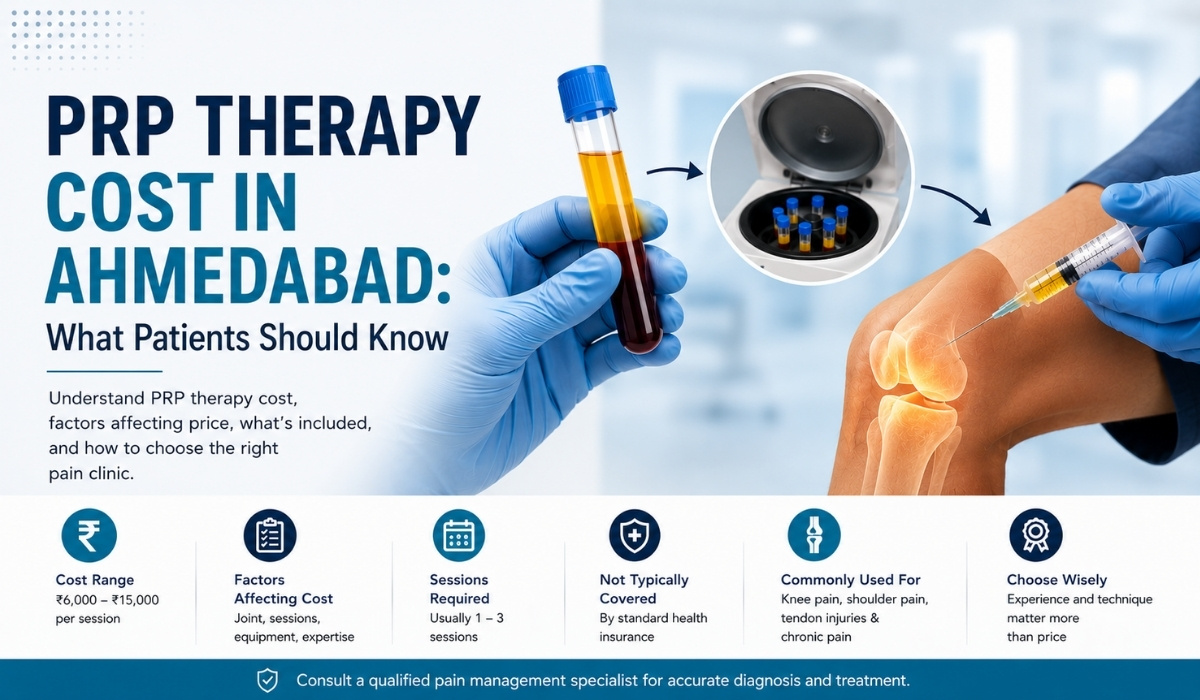

Quick Answer
PRP (Platelet-Rich Plasma) therapy in Ahmedabad typically costs between ₹6,000 and ₹15,000 per session, depending on the joint or area treated, the clinic’s equipment, and the number of sessions recommended. Most patients require 1 to 3 sessions spaced a few weeks apart. The exact cost depends on individual diagnosis, so a consultation with a qualified pain management specialist is the only reliable way to get an accurate estimate.
Quick Summary — Key Takeaways
- PRP therapy cost in Ahmedabad generally ranges from ₹6,000 to ₹15,000 per session.
- Cost depends on the treated area, number of sessions, clinic infrastructure, and physician expertise.
- Most patients need 1–3 sessions spaced 3–6 weeks apart for noticeable benefit.
- PRP is generally not covered by standard health insurance in India, as it is often classified as an elective regenerative treatment.
- PRP is commonly used for knee osteoarthritis, frozen shoulder, tendon injuries, and chronic joint pain.
- Results are gradual; PRP is not an instant cure and outcomes vary by patient.
- Choosing a clinic based on price alone, without checking technique and experience, is a common patient mistake.
Introduction
If you are exploring non-surgical options for chronic joint or tendon pain, you have likely come across Platelet-Rich Plasma (PRP) therapy. One of the first questions most patients ask is straightforward: how much does it cost? Understanding PRP therapy cost in Ahmedabad is not just about a number — it involves understanding what is included in that price, how many sessions you may realistically need, and whether the treatment fits your specific condition. This guide breaks down PRP pricing, the factors that influence it, and what to evaluate before choosing a clinic, so you can make an informed, confident decision.
What Is PRP Therapy?
Platelet-Rich Plasma therapy is a regenerative treatment that uses a concentrated portion of your own blood, rich in platelets and growth factors, to support the body’s natural healing response. A small blood sample is drawn, processed in a centrifuge to separate the platelet-rich component, and then injected into the affected joint, tendon, or soft tissue under sterile, image-guided conditions. It is commonly used to manage chronic pain in patients who want to avoid or delay surgery.
PRP Therapy Cost in Ahmedabad: Typical Price Range
Across reputable pain management and orthopedic clinics in Ahmedabad, PRP therapy is generally priced as follows. These figures are indicative; your actual cost will be confirmed only after a clinical evaluation.
| Treatment Area | Typical Cost per Session (₹) | Usual Number of Sessions |
| Knee Joint (Osteoarthritis) | 8,000 – 15,000 | 2–3 |
| Frozen Shoulder | 7,000 – 13,000 | 2–3 |
| Tennis Elbow / Tendon Injury | 6,000 – 12,000 | 1–3 |
| Other Joints (Hip, Ankle, Wrist) | 7,000 – 14,000 | 2–3 |
Factors That Influence PRP Therapy Cost
- Area being treated: Larger joints like the knee often require more plasma volume than smaller joints.
- Number of sessions: A single-session protocol costs less upfront than a 3-session course, though total cost should be compared, not just per-session price.
- Clinic infrastructure: Image-guided injections (ultrasound or fluoroscopy) typically cost more than blind injections but improve accuracy.
- Physician expertise: Treatment performed by a qualified interventional pain specialist may be priced differently than a general practitioner setting.
- PRP kit quality: Double-spin centrifuge kits that yield higher platelet concentration can affect pricing.
- Diagnostic workup: Pre-treatment imaging (X-ray, MRI, ultrasound) is usually billed separately.
Expert Insight
At Nexus Pain, we have observed that patients who compare clinics purely on the lowest quoted price often overlook whether the injection is image-guided. Accurate needle placement under ultrasound guidance materially affects outcomes, particularly for deep joints like the hip. A slightly higher cost for image-guided PRP is often a better long-term investment than a cheaper, non-guided injection.
Symptoms and Conditions PRP May Help With
- Persistent knee pain that worsens with activity or stair climbing
- Shoulder stiffness with restricted range of motion
- Localized tendon pain (elbow, heel, or knee tendons) that has not responded to rest
- Mild to moderate joint pain in patients wanting to avoid or delay surgery
Causes and Risk Factors Behind Chronic Joint Pain
- Age-related cartilage wear (osteoarthritis)
- Repetitive strain from occupational or sports activity
- Previous injury or incomplete rehabilitation
- Sedentary lifestyle leading to joint stiffness and muscle weakness
- Obesity, which increases mechanical load on weight-bearing joints
Diagnosis Before PRP Therapy
Before recommending PRP, a pain specialist typically conducts a clinical examination, reviews symptom history, and may order imaging such as X-ray, ultrasound, or MRI to confirm the diagnosis and severity of joint or tendon damage. This step is essential because PRP is not equally effective for every stage of joint degeneration, and a proper diagnosis helps set realistic expectations.
Non-Surgical Treatment Options Compared
| Treatment | Approximate Cost | Typical Duration of Relief |
| PRP Therapy | ₹6,000–15,000 per session | Several months, varies by patient |
| Corticosteroid Injection | ₹1,500–4,000 per session | Weeks to a few months |
| Physiotherapy (per session) | ₹500–1,500 | Ongoing, cumulative benefit |
| Surgical Intervention | Significantly higher, varies by procedure | Long-term, with recovery period |
This comparison is for general educational purposes. The right option depends on your diagnosis, severity, and overall health, and should be discussed with a qualified specialist.
Recovery and What to Expect After PRP
- Mild swelling or soreness at the injection site for 24–48 hours is common.
- Most patients resume light daily activity within 1–2 days.
- Noticeable improvement is usually gradual, often reported between 4 to 8 weeks.
- Strenuous activity is generally avoided for a short period as advised by your physician.
Real-Life Scenario
A 45-year-old office professional with early-stage knee osteoarthritis chose PRP after physiotherapy alone provided limited relief. Following a structured 3-session protocol with image guidance, she reported gradual improvement in stiffness and walking comfort over two months. Her experience reflects a typical, realistic PRP outcome — improvement, not an instant or guaranteed cure.
Prevention and Long-Term Joint Health
- Maintain a healthy weight to reduce joint load
- Incorporate low-impact strengthening exercises
- Avoid prolonged static postures, especially for office workers
- Address minor joint discomfort early rather than waiting for it to worsen
Common Mistakes Patients Make
- Choosing a clinic based solely on the lowest advertised price
- Expecting immediate or permanent pain relief after a single session
- Skipping post-procedure physiotherapy, which supports better outcomes
- Not asking whether the injection will be image-guided
Myths vs Facts
| Myth | Fact |
| PRP therapy completely cures arthritis. | PRP may reduce pain and improve function for some patients; it does not reverse joint degeneration. |
| The cheapest PRP clinic offers the same quality. | Technique, guidance method, and physician expertise significantly affect outcomes, not just price. |
| One PRP session is always enough. | Most evidence-based protocols use 2–3 sessions for meaningful results. |
| PRP is covered under all health insurance plans. | PRP is often considered elective and is typically not covered by standard insurance in India. |
Questions Patients Forget to Ask
- Is the injection image-guided (ultrasound/fluoroscopy) or a blind injection?
- How many sessions are realistically needed for my specific condition?
- What is included in the quoted price — consultation, imaging, follow-up?
- What is the physician’s experience with PRP for my specific joint?
- What happens if I see no improvement after the recommended sessions?
Practical Action Plan
- Schedule a clinical evaluation with a pain management specialist before assuming PRP is right for you.
- Ask for a written cost breakdown that includes consultation, imaging, and per-session pricing.
- Clarify whether the procedure will be image-guided.
- Discuss a realistic number of sessions and expected timeline for improvement.
- Plan for any recommended physiotherapy alongside PRP for better long-term outcomes.
Nexus Pain Expert Summary
PRP therapy can be a valuable, evidence-informed option for select patients with chronic joint or tendon pain who want to explore non-surgical pathways. Cost should never be the only deciding factor — diagnosis accuracy, injection technique, and physician experience matter just as much. At Nexus Pain, every PRP recommendation follows a comprehensive pain assessment and is discussed openly with the patient, including realistic expectations and transparent pricing.
How Nexus Pain Can Help
Nexus Pain Management Clinic in Ahmedabad supports patients through a structured, evidence-based approach to chronic and joint pain. This includes comprehensive pain assessment, personalized treatment planning, interventional pain procedures where appropriate, non-surgical pain management strategies, rehabilitation guidance, and long-term lifestyle modification support. The focus is on helping patients understand all available options — including PRP, physiotherapy, and other interventional pain procedures — so they can make an informed choice suited to their condition.
Key Takeaways
- PRP therapy cost in Ahmedabad typically ranges from ₹6,000 to ₹15,000 per session.
- Total cost depends on the joint treated, number of sessions, and clinic infrastructure.
- Image-guided PRP, though sometimes costlier, generally supports more accurate treatment.
- PRP works best as part of a broader treatment plan, not as a standalone quick fix.
- A proper diagnosis is essential before committing to PRP therapy.
- Insurance coverage for PRP is limited in most cases in India.
- Choosing a clinic should factor in expertise and technique, not price alone.
Frequently Asked Questions
What is the average PRP therapy cost in Ahmedabad?
Costs typically range from ₹6,000 to ₹15,000 per session depending on the joint treated and clinic infrastructure. A precise quote requires a clinical evaluation.
How many PRP sessions will I need?
Most evidence-based protocols recommend 2–3 sessions spaced a few weeks apart, though this varies based on individual diagnosis and severity.
Is PRP therapy painful?
Patients may feel mild discomfort during the injection and some soreness for 24–48 hours afterward, which is generally manageable.
Does insurance cover PRP therapy in India?
Most standard health insurance plans in India do not cover PRP therapy, as it is often categorized as an elective regenerative treatment. Check with your specific insurer.
How soon will I notice results after PRP?
Improvement is usually gradual, with many patients reporting noticeable change within 4 to 8 weeks after the full session protocol.
Is PRP therapy safe?
PRP uses your own blood, which lowers the risk of allergic reaction. As with any injection procedure, mild side effects like swelling or soreness can occur.
Can PRP replace surgery?
PRP may help delay or reduce the need for surgery in select cases, but it is not a guaranteed substitute and depends on the severity of the underlying condition.
What conditions is PRP commonly used for?
PRP is commonly used for knee osteoarthritis, frozen shoulder, tennis elbow, tendon injuries, and certain chronic joint pain conditions.
Why do PRP costs vary between clinics in Ahmedabad?
Variation comes from differences in equipment quality, whether the injection is image-guided, physician expertise, and the PRP kit used.
Should I choose the cheapest PRP clinic available?
Price should be weighed alongside physician experience, use of image guidance, and clinic reputation, not considered in isolation.
Can PRP therapy be combined with physiotherapy?
Yes, combining PRP with a structured physiotherapy plan is commonly recommended to support better functional outcomes.
Where can I get PRP therapy in Ahmedabad?
Pain management clinics in Ahmedabad, including Nexus Pain, offer PRP therapy as part of a broader non-surgical pain management approach.