
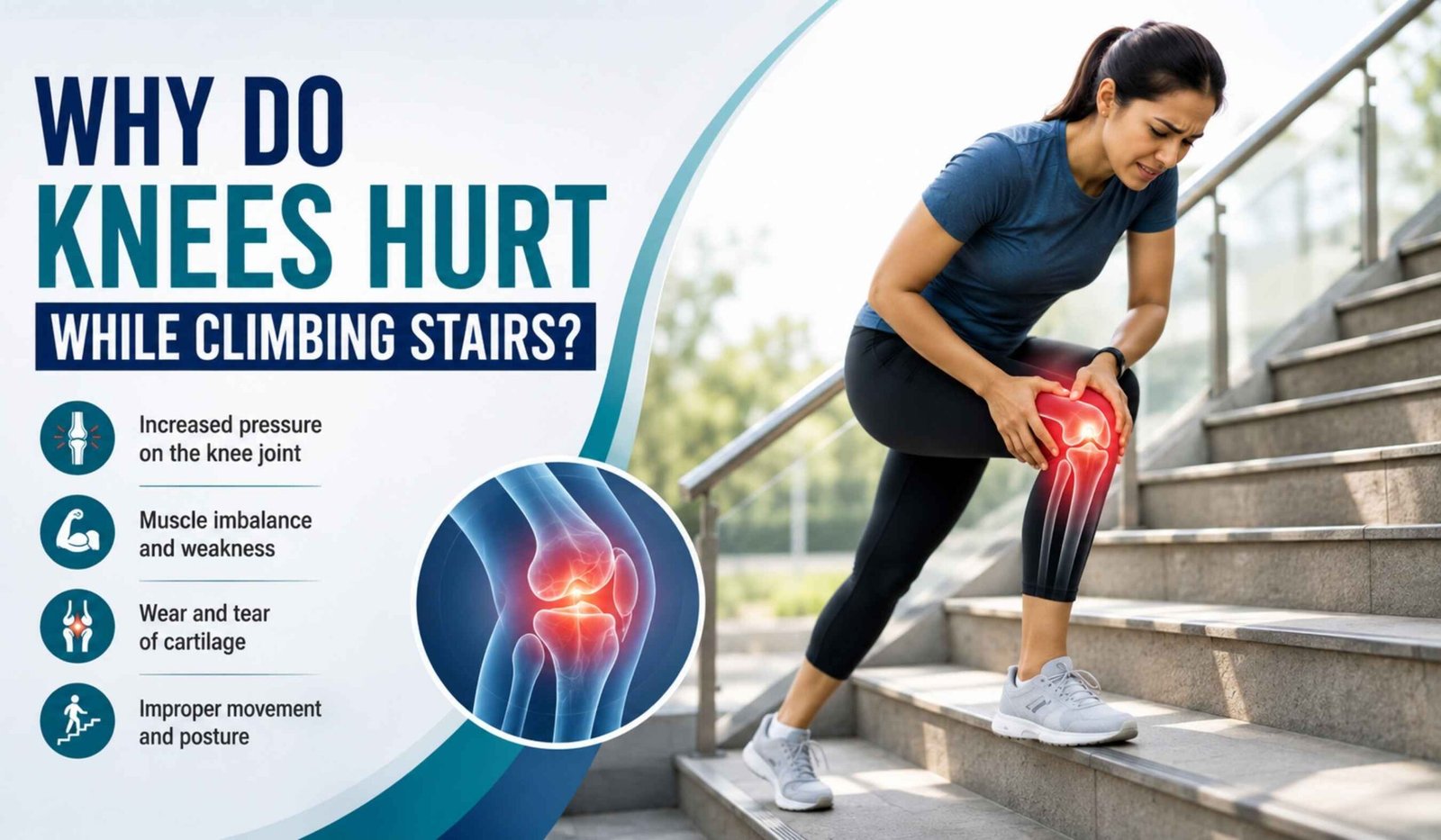

Quick Answer
| Knees hurt while climbing stairs because stairs place 3–4 times your body weight through the kneecap joint, far more than walking on flat ground. Pain is most often caused by patellofemoral pain syndrome (irritation under the kneecap), early cartilage wear, weak thigh muscles, or, in older adults, osteoarthritis. Most cases improve with targeted strengthening, activity modification, and non-surgical pain management — surgery is rarely the first step. |
Quick Summary
- Stairs load the kneecap joint 3–4x more than flat-ground walking, which is why pain often appears only on stairs.
- Descending is usually more painful than climbing because it requires the thigh muscles to control your body weight while lengthening (eccentric load).
- The most common cause in adults under 45 is patellofemoral pain syndrome; in adults over 50, early knee osteoarthritis is more likely.
- Weak or imbalanced thigh (quadriceps) muscles are a leading, correctable contributor.
- Pain that lasts more than 2–3 weeks, causes swelling, or is accompanied by locking or giving-way needs clinical evaluation.
- Most stair-related knee pain responds well to physiotherapy, activity modification, and non-surgical interventional treatment.
- A pain management specialist can identify the exact source of pain using clinical assessment and imaging, avoiding unnecessary surgery.
Introduction
Climbing or descending a flight of stairs is one of the most physically demanding everyday movements for the knee joint — more demanding, in fact, than walking or even jogging on level ground. So when a patient says, “My knees are fine most of the day, but stairs are unbearable,” that single detail is clinically meaningful. It tells us the problem is very likely centered on the kneecap (patellofemoral) joint rather than the whole knee, and it usually points toward a specific, identifiable cause rather than vague “wear and tear.”
This guide explains exactly why stairs trigger knee pain, what the common underlying causes are, how pain specialists diagnose the problem, and which non-surgical treatments genuinely help. The goal is not to alarm you — the goal is to help you understand your knee well enough to make an informed decision about what to do next.
Why Stairs Are So Hard on Your Knees
Every time you climb a step, your kneecap (patella) glides within a groove at the end of the thighbone (femur). This is called the patellofemoral joint. Research in joint biomechanics has consistently shown that this joint bears roughly 3–4 times your body weight when climbing stairs, compared to about 1–1.3 times your body weight during level walking. Descending stairs can place even greater strain on the joint, because your thigh muscles must contract while lengthening to control your descent — a pattern called eccentric loading, which is more taxing on both muscle and joint surface.
Why this matters: if your knee only hurts on stairs (and not on flat ground), the problem is almost always related to how load passes through the kneecap joint — not necessarily deep, structural damage inside the knee.
Common Symptoms of Stair-Related Knee Pain
- A dull, aching pain around or behind the kneecap when climbing or descending
- Sharp, catching pain on the first few steps, especially going downstairs
- A grinding, clicking, or crunching sensation (crepitus) with movement
- Mild swelling after stair use or prolonged sitting
- Stiffness after sitting with bent knees for a long time (“theatre sign”)
- A feeling that the knee may “give way” on stairs, particularly descending
What Causes Knee Pain While Climbing Stairs?
1. Patellofemoral Pain Syndrome (PFPS)
The single most common cause in active adults and young patients. It occurs when the kneecap doesn’t track smoothly in its groove, causing irritation of the cartilage and surrounding tissue under repetitive loading — exactly the kind of loading stairs produce.
2. Chondromalacia Patella
A softening or early wear of the cartilage on the underside of the kneecap. It shares symptoms with PFPS but reflects an actual, visible change in the cartilage surface, usually identified on imaging.
3. Knee Osteoarthritis
In patients over 45–50, progressive cartilage thinning across the joint is a common cause. Stair pain — particularly descending — is often one of the earliest reported symptoms of osteoarthritis, appearing before pain on flat ground.
4. Quadriceps Weakness or Imbalance
The quadriceps (thigh) muscles, especially the inner portion (vastus medialis), help guide the kneecap’s movement. Weakness or imbalance here is one of the most common — and most correctable — contributors to stair pain.
5. Patellar Tendinitis (“Jumper’s Knee”)
Overuse-related inflammation of the tendon just below the kneecap, common in athletes and people who recently increased stair-climbing, running, or squatting activity.
6. Meniscus Irritation
The meniscus (shock-absorbing cartilage between the thigh and shin bones) can become irritated or, in some cases, torn, causing pain that is often worse with twisting or descending motions.
7. IT Band Syndrome
Tightness in the iliotibial band running along the outer thigh can pull on the outer kneecap structures, producing pain that is frequently worse going down stairs.
Risk Factors
- Age over 45, particularly for osteoarthritis-related causes
- Sedentary lifestyle with weak thigh and hip muscles
- Sudden increase in stair use, running, or squatting activity
- Previous knee injury or surgery
- Being overweight, which multiplies joint loading on stairs
- Occupations requiring frequent stair or ladder use
- Flat feet or abnormal lower-limb alignment
How Is Stair-Related Knee Pain Diagnosed?
A pain management specialist typically begins with a detailed history — including exactly when the pain occurs (up vs. down stairs), its duration, and any swelling or instability — followed by a physical examination assessing kneecap tracking, muscle strength, and joint stability. Depending on findings, imaging such as X-ray (for joint space and arthritis) or MRI (for cartilage, tendon, or meniscus detail) may be recommended. Diagnosis is rarely guesswork; it is a structured process of ruling causes in or out.
| Expert Insight “Patients often assume stair pain automatically means arthritis, but in our clinical experience, patellofemoral pain syndrome and muscle weakness are far more common causes, particularly in patients under 50. A focused assessment usually identifies the exact source within one visit.” |
Treatment Options for Knee Pain on Stairs
Non-Surgical Treatment (First-Line Approach)
For the vast majority of patients, non-surgical, evidence-based management is the appropriate starting point:
- Targeted physiotherapy to strengthen the quadriceps, hips, and core
- Activity and load modification (e.g., using a handrail, reducing stair frequency temporarily)
- Anti-inflammatory strategies guided by a physician, where appropriate
- Bracing or taping to support kneecap tracking during recovery
- Interventional options such as targeted injections or PRP therapy for select cases of cartilage irritation or tendinitis
- Radiofrequency ablation (RFA) for select chronic osteoarthritis-related knee pain that hasn’t responded to conservative care
Surgery is generally considered only when structural damage (such as a significant meniscus tear or advanced arthritis) is confirmed and conservative treatment has not provided adequate relief.
Prevention Tips
- Strengthen the quadriceps and hip muscles with guided exercises 2–3 times per week
- Warm up before activities that involve repeated stair use
- Maintain a healthy body weight to reduce joint loading
- Use proper footwear with adequate cushioning and support
- Avoid sudden spikes in stair-climbing, running, or squat-based activity
- Address flat feet or alignment issues with orthotics if recommended
Recovery and Rehabilitation
Most cases of patellofemoral pain syndrome and mild chondromalacia improve within 6–12 weeks of consistent, guided physiotherapy. Recovery is typically progressive: initial pain reduction and swelling control in the first 1–2 weeks, followed by graded strengthening over 4–8 weeks, and a gradual return to full stair activity by week 8–12. Osteoarthritis-related pain follows a longer-term management pattern rather than a fixed recovery timeline, focused on symptom control and joint preservation.
Comparison: Climbing vs. Descending Stairs
| Aspect | Climbing (Ascending) | Descending |
| Muscle action | Concentric (muscle shortens) | Eccentric (muscle lengthens under load) |
| Typical joint stress | High | Higher — often the more painful direction |
| Common associated cause | Quadriceps weakness, tendinitis | PFPS, chondromalacia, early osteoarthritis |
| Typical sensation | Aching, fatigue-like pain | Sharp, catching, or unstable feeling |
Common Mistakes Patients Make
- Ignoring stair pain for months, assuming it will “just go away”, which allows muscle weakness and altered movement patterns to worsen.
- Resting completely instead of modifying activity — prolonged inactivity weakens the quadriceps further and can worsen symptoms.
- Self-diagnosing as “arthritis” and assuming surgery is inevitable, when most cases respond well to non-surgical care.
- Skipping professional strengthening guidance and doing generic online exercises that may not target the right muscles.
Myths vs. Facts
| Myth | Fact |
| Knee pain on stairs always means arthritis | It is often patellofemoral pain syndrome or muscle weakness, especially under age 50 |
| Rest is the best treatment | Guided activity and targeted strengthening usually work better than complete rest |
| Surgery is the only real fix | Most patients improve significantly with non-surgical, evidence-based treatment |
| Clicking or cracking always signals damage | Painless clicking (crepitus) is common and often not a sign of injury |
Questions Patients Forget to Ask
- Is my pain coming from the kneecap joint specifically, or the whole knee?
- What is causing my pain — is it muscular, cartilage-related, or joint-related?
- What is a realistic recovery timeline for my specific cause?
- Which exercises should I avoid until my pain improves?
- What are my non-surgical options before considering more invasive treatment?
Practical Action Plan
- Track your pain pattern for one week — note whether it’s worse going up, down, or both, and whether swelling occurs.
- Reduce (don’t eliminate) stair use temporarily and use a handrail for support.
- Begin gentle quadriceps and hip-strengthening exercises, ideally under guidance.
- Schedule an evaluation with a pain management specialist if pain persists beyond 2–3 weeks, or sooner if there is swelling, locking, or instability.
- Follow a structured, evidence-based treatment plan rather than a generic online routine.
Nexus Pain Expert Summary
| Stair-related knee pain is common, usually explainable, and in most cases treatable without surgery. At Nexus Advanced Pain Management, we begin with a comprehensive assessment to identify the exact source of your pain, then build a personalized, non-surgical treatment plan — from targeted physiotherapy to interventional options like PRP or radiofrequency ablation where appropriate — with realistic expectations and long-term joint health as the goal. |
How Nexus Pain Management Can Help
Nexus Advanced Pain Management takes an evidence-based approach to knee pain, beginning with a comprehensive assessment to identify the true source of your discomfort rather than treating symptoms generically. Our approach includes personalized, non-surgical treatment planning, interventional pain procedures where clinically appropriate, rehabilitation guidance, and long-term strategies for joint health and pain relief — all grounded in realistic expectations and patient education.
Key Takeaways
- Stairs load the kneecap joint 3–4x more than walking, which is why pain often appears there first.
- Descending stairs is frequently more painful than climbing due to eccentric muscle loading.
- Common causes include patellofemoral pain syndrome, chondromalacia, quadriceps weakness, and — in older adults — early osteoarthritis.
- Persistent pain beyond 2–3 weeks, swelling, or instability warrants professional evaluation.
- Non-surgical treatment is effective for the large majority of patients.
- A structured diagnosis prevents unnecessary worry and unnecessary surgery.
Frequently Asked Questions
Why does my knee only hurt on stairs and not when walking?
Stairs place several times more load through the kneecap joint than flat-ground walking, so problems localized to that joint — such as patellofemoral pain syndrome — often show up only on stairs.
Is it normal for knees to hurt while climbing stairs?
Occasional mild discomfort can occur with deconditioning, but persistent or worsening pain is not something to ignore and should be evaluated, particularly if it lasts more than 2–3 weeks.
Why is going down the stairs more painful than going up?
Descending requires your thigh muscles to control your body weight while lengthening (eccentric loading), which places greater stress on the kneecap joint than the muscle-shortening action used while climbing.
Can weak thigh muscles really cause knee pain on stairs?
Yes. Weak or imbalanced quadriceps muscles are one of the most common and most correctable contributors to stair-related knee pain, as they affect how the kneecap tracks during movement.
Does knee pain on stairs mean I have arthritis?
Not necessarily. While early osteoarthritis can present this way in adults over 45–50, patellofemoral pain syndrome and muscle weakness are more common causes in younger, active patients.
When should I see a pain specialist for knee pain on stairs?
See a specialist if pain persists beyond 2–3 weeks, is accompanied by swelling, clicking with pain, locking, instability, or if it is limiting your daily activities.
Can knee pain on stairs be treated without surgery?
Yes. Most cases respond well to physiotherapy, activity modification, and non-surgical interventional treatments; surgery is generally reserved for confirmed structural damage that hasn’t responded to conservative care.
What tests are used to diagnose stair-related knee pain?
Diagnosis typically starts with a clinical history and physical examination, followed by imaging such as X-ray or MRI when needed to assess cartilage, tendon, or joint condition.
How long does it take for stair-related knee pain to improve?
Many patients with patellofemoral pain syndrome improve within 6–12 weeks of consistent, guided treatment, though timelines vary depending on the underlying cause.
Can being overweight cause knee pain on stairs?
Yes. Excess body weight significantly increases the load passing through the kneecap joint during stair use, which can contribute to or worsen symptoms.
Is clicking or cracking in the knee on stairs a cause for concern?
Painless clicking (crepitus) is common and usually not concerning on its own; it becomes relevant mainly when accompanied by pain, swelling, or a catching sensation.
Where can I get evaluated for knee pain while climbing stairs in Ahmedabad?
Nexus Advanced Pain Management in Ahmedabad offers comprehensive knee pain assessment and evidence-based, non-surgical treatment planning for stair-related and activity-related knee pain.