
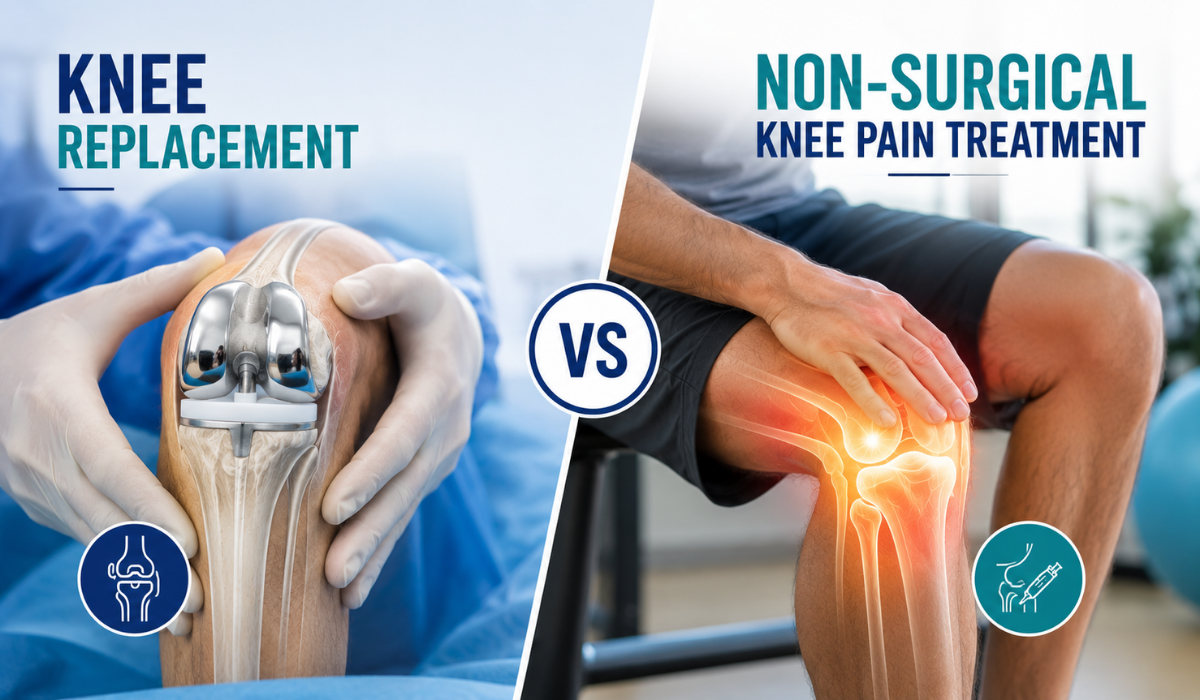

Quick Answer
| Non-surgical, interventional treatment — such as PRP therapy, viscosupplementation, a genicular nerve block, radiofrequency ablation (RFA), or ozone therapy — is often considered for knee osteoarthritis and can help manage pain and improve function for select patients. Total knee replacement becomes the more effective option when arthritis is advanced (grade 3–4), when non-surgical/interventional options no longer control symptoms, or when daily activity is severely limited. The right choice depends on a clinical assessment of your pain severity, functional limitation, imaging findings, previous treatment response, and personal goals — not on X-ray grade alone. |
Quick Summary
- Non-surgical or interventional treatment is often considered first for mild-to-moderate knee osteoarthritis, based on clinical assessment.
- Total knee replacement (TKR) tends to produce greater pain and function improvement than non-surgical care alone in patients with moderate-to-severe osteoarthritis, according to randomised trial data.
- A meaningful proportion of patients who begin non-surgical or interventional treatment are able to delay or manage their symptoms without surgery for a period of time; individual outcomes vary.
- Non-surgical/interventional options generally carry fewer immediate risks than surgery and do not require anaesthesia or a hospital stay.
- TKR recovery generally takes 3–6 months for most daily activities, with continued strength gains up to a year.
- The decision should be individualised — pain severity, functional limitation, imaging, previous treatment response, and patient goals all matter, not arthritis grade alone.
- A trial of appropriate non-surgical or interventional care before surgery is a reasonable approach for most patients without emergency indications.
Introduction
Knee pain from osteoarthritis is one of the most common reasons people in Ahmedabad visit an orthopaedic or pain management clinic. At some point, most patients are asked the same question: should you try non-surgical treatment, or is it time to consider knee replacement? Neither answer is universally correct — the right path depends on how far the arthritis has progressed, how the knee responds to conservative care, and what matters most to you: avoiding surgery, restoring full activity, or something in between. This article breaks down both pathways in practical terms, using current clinical evidence, so you can have a more informed conversation with your treating doctor.
Understanding the Two Pathways
Knee osteoarthritis develops when the cartilage cushioning the joint wears down, leading to pain, stiffness, and reduced mobility. Treatment generally follows a staged approach: conservative, non-surgical management first, with surgery reserved for patients whose symptoms and joint damage do not respond adequately.
Non-Surgical Knee Pain Treatment
At Nexus Pain Management, non-surgical treatment for knee osteoarthritis is approached through minimally invasive, interventional, injection-based, and regenerative options, selected based on individual assessment:
- PRP (Platelet-Rich Plasma) Therapy — a regenerative, injection-based option used to help manage symptoms in select patients as part of an individualized plan
- Viscosupplementation — a lubricating, injection-based option considered for appropriately selected patients with knee osteoarthritis
- Genicular Nerve Block — a targeted injection that addresses pain signalling from the nerves around the knee joint
- Radiofrequency Ablation (RFA) — a minimally invasive procedure that targets selected pain-transmitting nerves around the knee; it does not repair or regenerate cartilage
- Ozone Therapy — an interventional option some patients consider for knee pain; current evidence is limited, and it is not a cure or a way to reverse existing joint damage
- In some cases, more than one option may be combined, based on individual assessment findings
- Reassessment over time to guide whether the same treatment, a different option, or a combination is appropriate going forward
These treatments have different purposes and are not interchangeable — the right option, or combination, depends on the cause and severity of the pain, imaging findings, and how the knee has responded to treatment so far, determined through a clinical assessment at Nexus Pain Management, an advanced/interventional pain management clinic in Ahmedabad.
Total Knee Replacement (TKR)
Total knee replacement is a surgical procedure in which the damaged joint surfaces are resurfaced with an artificial implant. It is generally considered the definitive treatment for end-stage knee osteoarthritis (grade 3–4) once non-surgical measures no longer provide adequate relief. It is a major orthopaedic procedure requiring hospital admission, anaesthesia, and a structured rehabilitation programme afterward.
What the Evidence Shows
A randomised controlled trial published in the New England Journal of Medicine compared patients with moderate-to-severe knee osteoarthritis who were eligible for TKR, assigning them to either surgery followed by non-surgical care, or non-surgical care alone. At 12 months, the surgery group showed significantly greater improvement in the Knee Injury and Osteoarthritis Outcome Score (KOOS), which measures pain, symptoms, daily function, and quality of life. A related 2-year follow-up found the same pattern held over time, though patients who started with non-surgical treatment alone still showed meaningful improvement compared to written advice only.
It is worth noting that a proportion of patients who begin with non-surgical or interventional treatment do eventually proceed to knee replacement, while others continue to manage without surgery for an extended period. This is the key clinical takeaway: non-surgical and interventional treatment is not a guaranteed alternative to surgery for advanced arthritis, but it can allow many patients to delay it or manage effectively for a period of time while maintaining function.
Knee Replacement vs. Non-Surgical Treatment: Side-by-Side Comparison
| Factor | Non-Surgical Treatment | Total Knee Replacement |
| Best suited for | Mild-to-moderate osteoarthritis, or patients seeking to manage symptoms before considering surgery | Advanced (grade 3–4) osteoarthritis, failed conservative care |
| Pain relief | Varies by treatment and patient; options target different mechanisms (e.g., the joint itself vs. pain-signalling nerves) | Generally greater improvement in trial data |
| Recovery time | Minimal downtime for most options; effects and duration vary by treatment type | 3–6 months for most activities; up to 12 months for full strength |
| Risk profile | Low; localized, injection-related risks only, and vary by treatment type | Surgical and anaesthesia-related risks apply |
| Reversibility | Non-permanent; treatment plan can be adjusted or changed | Permanent structural change to the joint |
| Typical first step | Often considered before surgery, depending on assessment | Considered after non-surgical options are exhausted |
| Ongoing commitment | Periodic reassessment and, where appropriate, repeat or combined interventional treatment | Structured rehab, then long-term joint care |
Recovery and Rehabilitation
Recovery expectations differ meaningfully between the two pathways, and this is often the deciding factor for working professionals and homemakers weighing their options.
Non-Surgical / Interventional Treatment Pattern
There is no surgical downtime. Response to treatment varies by option and by patient, and some treatments may be repeated or combined based on how symptoms respond, with periodic reassessment (typically every 4–8 weeks) to check whether the current approach is working.
TKR Recovery Pattern
- Days 1–3: Hospital stay; walking with assistance typically begins within a day or two
- Weeks 2–3: Transition to a cane or walking unaided for many patients; a structured post-surgical rehabilitation programme often begins
- Weeks 6–12: Return to light daily activities and desk-based work; low-impact activity gradually reintroduced
- Months 3–6: Continued strengthening; many patients resume low-impact recreational activity
- Months 6–12: Further gains in strength and stability for most patients
Recovery timelines vary by age, general health, pre-surgical fitness, and adherence to the post-surgical rehabilitation programme — these figures are general patterns, not guarantees for any individual patient.
Expert Insight
| Expert Insight 1 — On Timing One of the most common mistakes we see is patients waiting too long to explore non-surgical or interventional treatment, and then expecting it to work as quickly as they hoped once the arthritis has already progressed. Starting an appropriate option early, while the joint damage is still mild to moderate, generally gives it the best chance to delay or reduce the need for surgery. |
| Expert Insight 2 — On Realistic Expectations Non-surgical and interventional treatment options are not designed to reverse cartilage loss. Their role is to help manage pain and maintain function for as long as reasonably possible. Patients who understand this go in with realistic expectations. |
| Expert Insight 3 — On Deciding for Surgery The decision to proceed with knee replacement is rarely made on X-rays alone. We look at how much the knee is limiting daily life — walking, stairs, sleep — alongside imaging findings and how the joint has responded to a genuine trial of conservative care. |
Common Mistakes to Avoid
- Trying a single treatment in isolation without a proper clinical assessment, then concluding non-surgical or interventional treatment “doesn’t work.”
- Delaying any evaluation until the knee is severely deformed or activity is completely restricted, which narrows treatment options.
- Assuming knee replacement guarantees a pain-free knee — most patients see major improvement, but realistic expectations and rehab commitment matter.
Myths vs. Facts
| Myth | Fact |
| “Surgery is always the better choice.” | For mild-to-moderate arthritis, non-surgical treatment often provides adequate relief; surgery is generally reserved for advanced disease or failed conservative care. |
| “Non-surgical treatment is a waste of time before surgery anyway.” | Many patients are able to manage symptoms and delay surgery for a period of time with appropriately selected non-surgical or interventional treatment, though outcomes vary by individual. |
| “PRP therapy cures arthritis.” | PRP may help manage symptoms in select patients as part of an individualized plan; it does not reverse existing cartilage damage. |
| “Knee replacement means months of being bedridden.” | Most patients begin walking with assistance within a day or two and progress steadily over the following weeks. |
Questions Patients Forget to Ask
- How advanced is my arthritis on imaging, and what does that mean for my options?
- How long should I trial a non-surgical or interventional option before reassessing?
- What specific outcome am I trying to achieve — pain relief, return to sport, or basic mobility?
- What does my occupation or daily routine require from my knee?
- What is the realistic recovery timeline for someone my age and fitness level?
Practical Action Plan
- Clinical assessment to understand your knee pain and overall health.
- Identification of the cause and severity of the knee pain.
- Imaging when clinically appropriate.
- Discussion of suitable non-surgical/interventional options.
- Individualized treatment selection.
- Reassessment of treatment response.
- Surgical evaluation when symptoms remain severe and surgery is clinically appropriate.
Nexus Pain Expert Summary
| Most patients with knee osteoarthritis benefit from a thorough clinical assessment and consideration of non-surgical or interventional options before proceeding to surgery. The exception is advanced, grade 3–4 arthritis with significant functional limitation that has not responded to appropriate treatment, where knee replacement generally becomes the more appropriate option. The most important step is an accurate, individualized assessment early on, so the treatment recommendation matches the actual severity of the joint damage and the patient’s goals. |
Key Takeaways
- Non-surgical and interventional treatment is often an appropriate option to consider first for mild-to-moderate knee osteoarthritis, based on clinical assessment.
- Total knee replacement shows greater improvement in trial data for moderate-to-severe cases that don’t respond to conservative care.
- Many patients are able to delay or avoid surgery for a period of time with appropriately selected non-surgical or interventional treatment; outcomes vary by individual.
- Recovery from TKR generally spans 3–6 months for most activities, with gains continuing up to a year.
- The decision should be based on pain severity, functional limitation, imaging findings, and response to treatment — not on imaging alone.
- Neither pathway guarantees a specific outcome — individual results vary.
How Nexus Pain Can Help
Nexus Pain Management is an advanced pain management and interventional pain management clinic in Ahmedabad, supporting patients at every stage of the knee pain decision-making process. This includes a thorough clinical assessment to identify the cause and severity of knee pain, imaging when clinically appropriate, and discussion of suitable non-surgical/interventional options — including PRP therapy, viscosupplementation, genicular nerve block, radiofrequency ablation, and ozone therapy — alongside clear guidance on when a surgical evaluation may be warranted. Start with a clinical assessment at Nexus Pain Management to receive an accurate diagnosis and an individualized treatment recommendation for your knee pain.
Frequently Asked Questions
Q: Is non-surgical treatment effective for knee osteoarthritis?
A: For many patients with mild-to-moderate osteoarthritis, non-surgical and interventional options such as PRP therapy, viscosupplementation, a genicular nerve block, RFA, or ozone therapy can help manage pain and improve function, depending on individual assessment. Effectiveness varies by patient and by arthritis severity.
Q: When should I consider knee replacement instead of non-surgical treatment?
A: Knee replacement is typically considered when pain severity, functional limitation, and imaging findings together indicate advanced (grade 3–4) osteoarthritis, and non-surgical or interventional treatment no longer provides adequate relief. The decision is based on clinical assessment, not imaging alone.
Q: Does non-surgical treatment delay the need for surgery?
A: For many patients, appropriately selected non-surgical or interventional treatment can help delay the need for surgery, though how long this lasts varies from person to person and depends on arthritis severity and treatment response.
Q: How long does recovery take after total knee replacement?
A: Most patients resume light daily activities within 6–12 weeks and continue to gain strength for up to a year. Individual recovery time depends on age, health, and rehabilitation adherence.
Q: Is PRP therapy a substitute for knee replacement?
A: No. PRP therapy may help manage symptoms for some patients as part of a broader non-surgical plan, but it does not reverse existing cartilage damage or replace surgery in advanced arthritis.
Q: What are the risks of delaying knee replacement surgery?
A: Delaying surgery in advanced arthritis can mean prolonged pain and functional limitation, but it is not automatically harmful — many patients safely continue non-surgical management for extended periods under medical supervision.
Q: Can younger patients avoid knee replacement with non-surgical treatment?
A: Many younger patients with early-stage arthritis respond well to non-surgical or interventional treatment and may be able to delay surgery significantly, depending on individual assessment and response to treatment.
Q: What non-surgical/interventional treatment options does Nexus Pain Management offer for knee pain?
A: At Nexus Pain Management, options may include PRP therapy, viscosupplementation, a genicular nerve block, radiofrequency ablation, or ozone therapy, selected based on a clinical assessment of the cause and severity of your knee pain.
Q: Is knee replacement painful?
A: Post-surgical pain is expected and managed with medication in the initial recovery period; pain typically decreases progressively over the following weeks as healing and rehabilitation progress.
Q: How do doctors decide which treatment is right for a specific patient?
A: The decision considers imaging findings, symptom severity, functional limitation, response to prior treatment, age, and the patient’s personal activity goals.
Q: Where can I get a knee pain evaluation in Ahmedabad?
A: Nexus Pain Management, an advanced pain management and interventional pain management clinic in Ahmedabad, offers comprehensive knee pain assessment covering both non-surgical/interventional and surgical-pathway guidance to help you understand your options.
Q: Can non-surgical treatment and surgery be used together?
A: Yes. Even patients who proceed with knee replacement generally follow a structured post-surgical rehabilitation programme to support recovery, separate from the non-surgical/interventional treatments used before surgery.