

Quick Answer
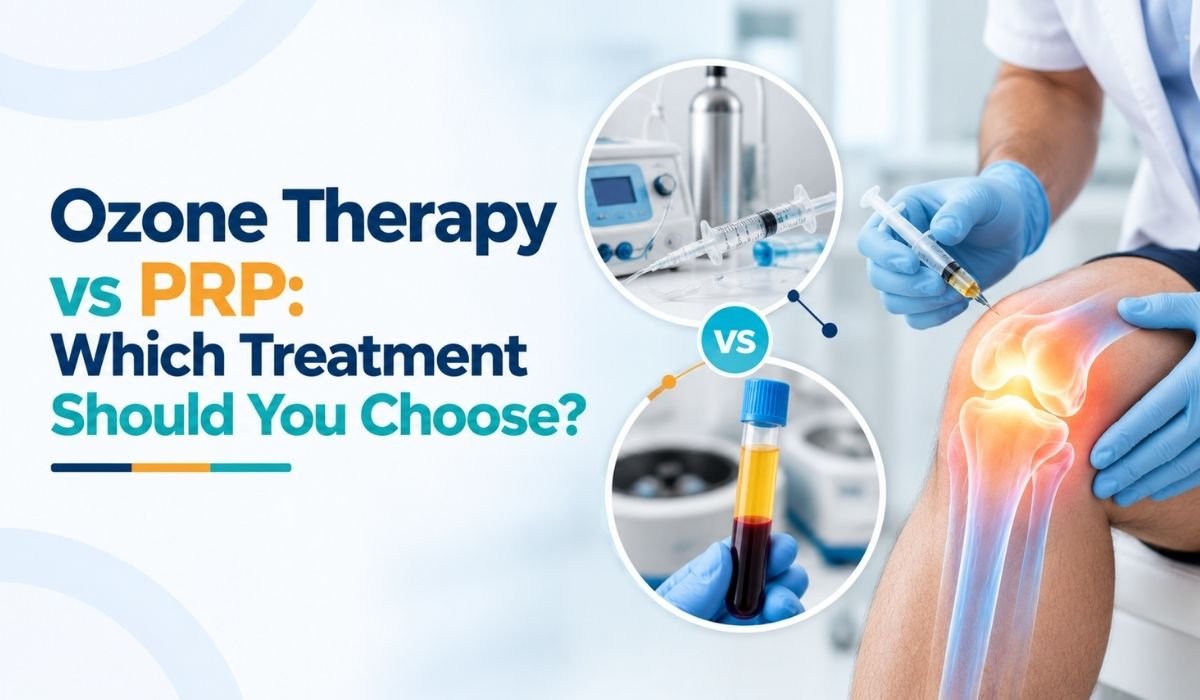
Neither treatment is better for everyone. In knee osteoarthritis research, ozone injections often bring relief sooner, while PRP (platelet-rich plasma) has shown longer-lasting benefit, up to 12 months in some trials. Ozone is usually cheaper per session but given as a repeated series, and its safety and regulatory standing are more contested. The right choice depends on your diagnosis, joint condition, medical history and goals, so a proper pain assessment should come first.
Quick Summary
- PRP is made from your own blood; ozone therapy uses a medical oxygen-ozone gas mixture.
- Ozone often works faster, but its effect tends to fade by around six months.
- PRP has shown longer relief in several comparative trials.
- Studies do not all agree, and most focus on knee arthritis.
- Guidelines are cautious about PRP, and the US FDA has not authorised medical ozone.
Introduction
If you live with knee pain, arthritis or a stubborn joint injury, you may have been offered PRP, ozone therapy or both, often with little explanation. Both are non-surgical injections that doctors sometimes consider after tablets, physiotherapy and lifestyle changes have not been enough. They are not interchangeable. This guide explains how each works, what research shows about speed and duration of relief, the safety discussion, and how to decide with your doctor.
What Are PRP and Ozone Therapy?
How PRP Works
PRP is prepared from a small sample of your own blood, spun in a centrifuge to concentrate platelets, then injected into the painful joint or tendon. Platelets release growth factors, which are thought to calm inflammation and support tissue repair.
How Ozone Therapy Works
Ozone therapy uses a mixture of medical-grade oxygen and ozone (O3). For joint pain, it is injected into the joint; some spine protocols place it near the disc or nerve root. It is thought to modulate inflammation and oxidative stress.
Ozone Therapy vs PRP at a Glance
| Feature | PRP | Ozone therapy |
| Material | Concentrate from your own blood | Medical oxygen-ozone gas mixture |
| Typical course | Often 1 to 3 injections | Often a weekly series; trials used about 3 to 8 injections |
| Speed of relief | Gradual | Often earlier, within 1 to 2 months in trials |
| Duration in knee trials | Up to 12 months | Often fades by about 6 months |
| Evidence | Larger body of trials; guidelines still cautious | Smaller studies, lower quality overall |
| Per-session cost | Usually higher | Usually lower, but more sessions |
What Does the Research Show?
Most head-to-head research is in knee osteoarthritis, so that is where the picture is clearest.
Speed of Relief
In a 2021 randomised trial of 238 people with mild to moderate knee osteoarthritis, ozone gave the best results at two months.
How Long Relief Lasts
That same trial found only PRP and a related product (PRGF) outperformed hyaluronic acid and ozone at 12 months. A 2017 randomised trial reported that ozone’s effect had disappeared by month six, while PRP’s continued. A meta-analysis of 12 studies reached a similar conclusion: PRP showed better results at 6 to 12 months, while ozone had short-term results.
Where Studies Disagree
A smaller trial with 27 patients per group found ozone about as effective as PRP, with no side effects in either group. A retrospective study found PRP alone and PRP combined with ozone similarly effective, with the combination linked to less post-injection pain. Small samples, different protocols and varied follow-up make these findings hard to generalise.
Beyond the Knee
Evidence for back, neck, shoulder or tendon problems is thinner. A 2021 systematic review of ozone trials for low back pain described overall poor methodological quality, and PRP data for chronic low back pain come from only a few small trials. Treat claims of superiority in these conditions cautiously.
A Guideline Reality Check
Even PRP is not endorsed everywhere. A 2023 overview showed a limited recommendation from AAOS (2021) and no recommendation from OARSI or ACR (both 2019), although a French-speaking expert consensus considers PRP effective for early to moderate knee arthritis. “Better supported than ozone” does not mean “proven for everyone.”
Safety: What Patients Should Know
Both are injections, so soreness, swelling and, rarely, joint infection are possible. Because PRP uses your own blood, its risks are largely procedural.
Ozone needs a more careful conversation. The US FDA has not authorised ozone for any medical condition and describes ozone gas as toxic when inhaled, although regulation differs by country. Serious events have been reported in case reports, mainly with systemic routes, and one report described septic arthritis after ozone treatment, though the authors could not establish cause. A meta-analysis of joint injections found adverse event rates similar to control injections (about 4% vs 5.4%). For both treatments, technique, equipment and clinician experience matter.
Which Treatment Fits Which Situation?
This is general education, not advice for any individual.
- Mild to moderate knee arthritis, longer relief wanted: PRP has the stronger comparative evidence.
- Quicker, shorter-term relief and lower session cost: ozone is sometimes discussed, with the trade-offs above.
- Advanced joint damage: most trials enrolled mild to moderate arthritis, so results may not apply. Other interventional options, such as radiofrequency ablation, may be discussed.
- Blood thinners, clotting disorders or cancer history: specialist review is essential, as trials often excluded these groups.
Myths vs Facts
- Myth: PRP or ozone regrows cartilage. Fact: Trials mainly measure pain and function, not reliable cartilage regrowth.
- Myth: Ozone is just cheaper PRP. Fact: They differ in mechanism, duration and safety profile.
- Myth: Using your own blood means zero risk. Fact: Any joint injection carries infection and soreness risk.
Questions Patients Forget to Ask
- What is my exact diagnosis, and how advanced is it?
- Why this treatment over exercise therapy, hyaluronic acid or a steroid injection?
- How many sessions will I need, and what is the total cost?
- How long might relief last, and how will we measure progress?
Practical Action Plan
- Note your symptoms: location, duration, triggers and what you have already tried.
- Book a pain specialist assessment, with imaging where needed.
- Use the questions above to compare options against your goals.
- Follow pre- and post-procedure instructions and any exercise plan.
Seek urgent care if, after any joint injection, you develop fever, a hot, red or rapidly swelling joint, or sharply worsening pain.
Nexus Advanced Pain Management Expert Summary
PRP versus ozone is rarely an either-or question answered in isolation. Research suggests ozone tends to act earlier and PRP tends to last longer in knee osteoarthritis, but evidence is limited, protocols differ and results vary between people. Injections work best as one part of a plan that includes exercise, activity management and realistic expectations. A treatment should be chosen because it fits your diagnosis, not because it is popular or cheaper.
How Nexus Advanced Pain Management Can Help
Nexus Advanced Pain Management in Ahmedabad offers both PRP Therapy and Ozone Therapy among its regenerative and interventional options, alongside injections for pain relief and chronic pain management. Care begins with a comprehensive pain assessment to confirm the cause of your pain. A personalised, evidence-based plan is then discussed, covering non-surgical options, expected benefits and limits, and the rehabilitation that supports recovery.
Key Takeaways
- Ozone often acts earlier; PRP has shown longer relief in knee trials.
- Evidence is strongest for knee osteoarthritis, thinner elsewhere.
- Guidelines are cautious about PRP; the FDA has not authorised medical ozone.
- Both carry injection risks; ozone raises extra regulatory and route-specific questions.
- Choose after assessment, not by price or trend alone.
Frequently Asked Questions
Is ozone therapy better than PRP for knee pain?
Neither is better for everyone. Ozone often acts faster, while PRP has shown longer-lasting relief in several knee osteoarthritis trials. Your diagnosis and medical history should guide the choice.
Which lasts longer, PRP or ozone therapy?
In comparative knee studies, PRP benefits lasted up to 12 months, whereas ozone benefits often faded by around six months. Duration varies between individuals and conditions.
Can PRP and ozone therapy be combined?
Some studies have combined them, finding similar overall effectiveness and, in one, less post-injection pain. Evidence is limited, so ask your doctor why a combination is being suggested.
Is ozone therapy safe for joints?
Intra-articular ozone showed adverse event rates similar to control injections in one meta-analysis, but the US FDA has not authorised medical ozone, and serious events are reported with some routes. Experienced administration matters.
How many sessions do PRP and ozone therapy need?
PRP is often given as one to three injections, while ozone is commonly a weekly series. Studies used roughly three to eight ozone injections, and your doctor will set a plan after assessment.
Who should be cautious about these injections?
People taking blood thinners, with clotting disorders, or with a cancer history need specialist review first. Trials often excluded these groups, so results may not apply to them.
Where can I get PRP or ozone therapy in Ahmedabad?
Nexus Advanced Pain Management in Ahmedabad offers both PRP Therapy and Ozone Therapy. A pain assessment comes first, so the treatment is matched to your diagnosis.