
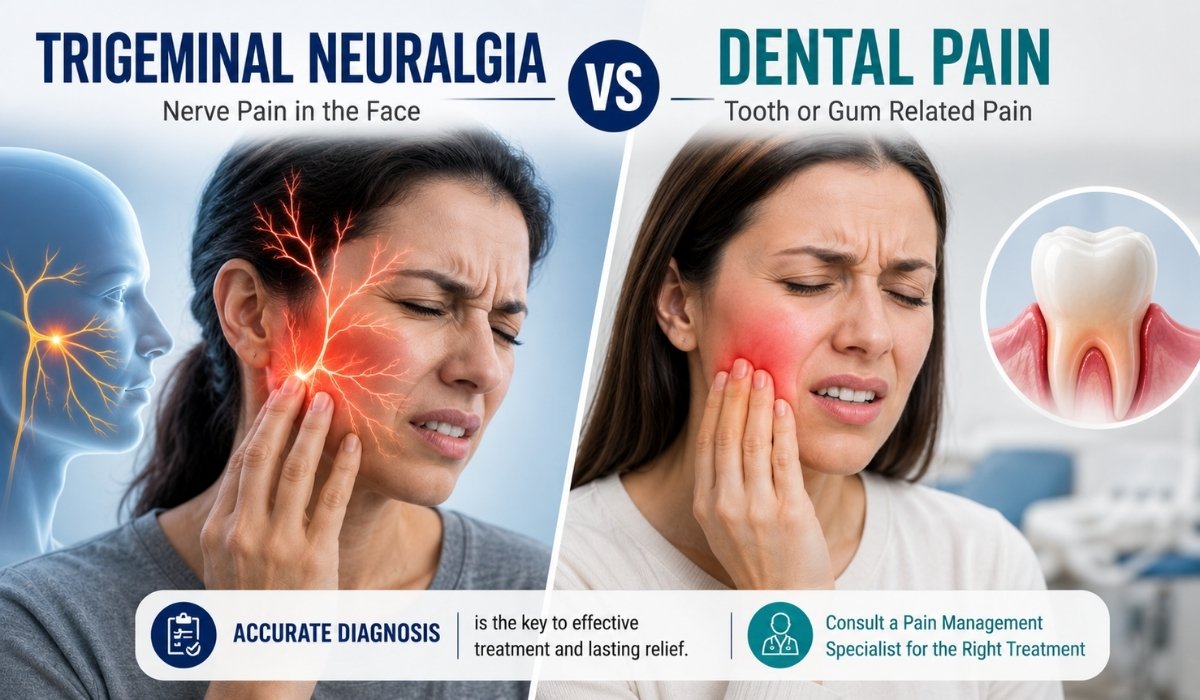

Quick Answer
| Dental pain is usually a dull, continuous ache that worsens with biting, hot or cold foods, and is typically linked to a visible cavity, cracked tooth, or gum problem. Trigeminal neuralgia (TN) causes sudden, brief, electric-shock-like pain that comes in short attacks (seconds to about two minutes), often triggered by light touch, brushing teeth, chewing, or even a breeze on the face, without any dental abnormality on examination or X-ray. If facial or tooth pain persists despite normal dental findings, or continues after dental treatment, a neurological evaluation for trigeminal neuralgia is worth pursuing. |
Quick Summary
- Dental pain is typically continuous, dull-to-throbbing, and tied to a specific tooth or gum issue visible on exam or X-ray.
- Trigeminal neuralgia causes brief, severe, shock-like pain attacks lasting seconds, usually triggered by light stimuli.
- TN is frequently misdiagnosed as dental pain, leading to unnecessary root canals or extractions.
- A key red flag: pain that continues, or worsens, after dental treatment despite no ongoing dental pathology.
- Diagnosis relies mainly on a detailed pain history, supported by MRI to rule out secondary causes.
- First-line treatment for TN is medication (carbamazepine or oxcarbazepine), not dental intervention.
- Persistent, unexplained facial pain deserves evaluation by both a dentist and a pain/neurology specialist.
Introduction
Facial pain can be genuinely confusing to diagnose because a toothache and a nerve-related pain condition can feel deceptively similar at first. Trigeminal neuralgia (TN), a condition affecting the trigeminal nerve that supplies sensation to the face, is one of the most commonly misdiagnosed causes of facial pain — often mistaken for a dental problem in its early stages. This confusion isn’t just an inconvenience: it frequently leads patients through unnecessary root canals, extractions, or repeated dental procedures before the real cause is identified. This article outlines the key clinical differences between trigeminal neuralgia and dental pain so you know what to look for and when to seek a specialist opinion.
Why the Confusion Happens
Both dental pain and trigeminal neuralgia can affect the same region of the face and jaw, and both can be triggered by chewing, brushing, or temperature changes. Some patients with early or ‘pre-trigeminal’ neuralgia even experience a dull, continuous ache before the classic shock-like pain develops — a presentation that closely mimics pulpitis or an inflamed tooth nerve. Because dental pain is far more common than trigeminal neuralgia, it is reasonable for a dentist to investigate dental causes first. The problem arises when pain persists despite normal examination and imaging findings, and treatment continues to target the teeth rather than the nerve.
Dental Pain: Typical Characteristics
- Continuous, dull-to-throbbing pain rather than brief shocks
- Often worsens with hot, cold, or sweet foods and pressure from biting
- Usually localized to one identifiable tooth or area, sometimes with visible swelling or decay
- Confirmed by clinical examination and dental X-rays showing caries, a cracked tooth, an abscess, or gum disease
- Generally responds to dental treatment — filling, root canal, or extraction — once the source is treated
Trigeminal Neuralgia: Typical Characteristics
- Sudden, severe, electric-shock-like or stabbing pain lasting from a few seconds up to about two minutes
- Pain is paroxysmal — it comes in attacks with pain-free intervals in between (though some patients also have a background ache)
- Frequently triggered by light stimuli: brushing teeth, chewing, talking, shaving, cold air, or a light touch to the face
- Follows the distribution of one or more branches of the trigeminal nerve, usually on one side of the face
- No visible dental abnormality on examination or X-ray to explain the pain
- Often does not respond to dental treatment or standard analgesics
Trigeminal Neuralgia vs. Dental Pain: Side-by-Side Comparison
| Feature | Dental Pain | Trigeminal Neuralgia |
| Pain character | Dull, aching, throbbing | Sharp, electric-shock-like, stabbing |
| Duration | Continuous or prolonged | Seconds to about 2 minutes per attack |
| Pattern | Persistent until treated | Paroxysmal, with pain-free intervals |
| Triggers | Hot/cold foods, biting, pressure | Light touch, brushing, wind, talking, chewing |
| Exam/X-ray findings | Usually shows a dental cause | Usually normal; no dental pathology found |
| Response to dental treatment | Improves once tooth is treated | Typically unchanged or unrelieved |
| First-line treatment | Dental procedure (filling, root canal, etc.) | Anticonvulsant medication (e.g., carbamazepine) |
How Trigeminal Neuralgia Is Diagnosed
Diagnosis is based primarily on a detailed pain history — the character, duration, triggers, and pattern of the pain are usually distinctive enough to raise suspicion. A thorough examination of the teeth, gums, and jaw is still important to rule out a dental cause first. Once dental and TMJ causes are excluded, an MRI of the brain is generally recommended to check for vascular compression of the trigeminal nerve near the brainstem, or to rule out rarer secondary causes such as multiple sclerosis or a structural lesion, particularly in younger patients.
Treatment Approaches
For Trigeminal Neuralgia
- Anticonvulsant medication such as carbamazepine or oxcarbazepine is the established first-line treatment and is often effective at controlling attacks
- Additional medications (gabapentin, pregabalin, or others) may be added if the first-line drug is insufficient or poorly tolerated
- Microvascular decompression (MVD) is considered when medication fails or causes significant side effects, and offers the highest rates of long-term pain relief among surgical options, though it carries surgical risks and recurrence is possible over time
- Other procedural options (percutaneous procedures, stereotactic radiosurgery) may be considered when MVD is not suitable, with different risk-benefit and durability profiles
For Dental Pain
Treatment targets the identified dental cause — this may include a filling, root canal treatment, extraction, or periodontal therapy. Pain typically resolves once the underlying dental problem is addressed.
Expert Insight
| Expert Insight 1 — On Unnecessary Procedures One of the most important things a patient can do is pause before agreeing to a second or third dental procedure if the first one didn’t relieve the pain. If an X-ray and clinical exam don’t show a clear dental cause, that’s the moment to ask about a nerve-related evaluation rather than proceeding further with dental treatment. |
| Expert Insight 2 — On Pain Pattern The single most useful clue is the pattern of the pain, not just its location. A toothache that is always there and gets worse with hot or cold food behaves very differently from an attack that lasts a few seconds and is set off by a light touch or a gust of air. |
| Expert Insight 3 — On Timely Referral Trigeminal neuralgia responds well to appropriate medical treatment in many patients, but delays in diagnosis mean delays in relief. If dental causes have genuinely been ruled out, prompt referral to a pain specialist or neurologist matters more than continuing to observe and wait. |
Common Mistakes to Avoid
- Continuing repeated dental procedures on a tooth that shows no clear pathology, hoping the pain will eventually resolve.
- Assuming all facial pain that involves the teeth or jaw must be dental in origin.
- Delaying an MRI or specialist evaluation when pain doesn’t fit the typical dental pattern and hasn’t responded to dental treatment.
Myths vs. Facts
| Myth | Fact |
| “If the pain is in my tooth or jaw, it must be a dental problem.” | Trigeminal neuralgia pain can localize to the teeth or jaw even though the actual problem is in the nerve, not the tooth. |
| “A root canal will eventually fix it if the pain keeps coming back.” | If exams and X-rays show no dental cause, repeating dental procedures is unlikely to help and may delay the correct diagnosis. |
| “Trigeminal neuralgia always causes constant pain.” | Classic TN is paroxysmal — brief attacks with pain-free intervals — though some patients also have a background ache between attacks. |
| “Nerve pain in the face is always a sign of something dangerous.” | Most cases are due to benign vascular contact with the nerve; MRI helps rule out the less common secondary causes. |
Questions Patients Forget to Ask
- Has a dental cause been fully ruled out with both examination and X-rays?
- Does my pain pattern match brief, shock-like attacks or a continuous ache?
- Should I get an MRI before undergoing another dental procedure?
- What triggers seem to bring on my pain, and does that match a dental or nerve pattern?
- If medication is prescribed, how long should I expect to try it before reassessing?
Practical Action Plan
- Get a thorough dental examination and X-rays to confirm or rule out a dental cause.
- Track your pain pattern: duration, triggers, and whether it is continuous or comes in brief attacks.
- If pain continues despite normal dental findings, or after dental treatment, seek a pain specialist or neurology evaluation.
- Discuss an MRI to check for nerve compression or rule out secondary causes, particularly if you are under 40.
- If trigeminal neuralgia is diagnosed, begin with first-line medication and track response before considering procedural options.
Nexus Pain Expert Summary
| Dental pain and trigeminal neuralgia can look similar on the surface but behave very differently once you look closely at the pattern, duration, and triggers. The most reliable safeguard against unnecessary treatment is a clear dental work-up first, followed by a specialist pain or neurology evaluation if the pain doesn’t match a dental cause or doesn’t resolve with dental treatment. Getting the diagnosis right early prevents unnecessary procedures and gets patients onto effective treatment sooner. |
Key Takeaways
- Dental pain is continuous and tied to a visible tooth or gum problem; TN is brief, shock-like, and triggered by light stimuli.
- TN is one of the most commonly misdiagnosed causes of facial pain, often mistaken for a dental issue.
- Pain that persists after dental treatment, with no ongoing dental pathology, warrants specialist evaluation.
- Diagnosis relies on pain history first, with MRI used to check for nerve compression or rule out secondary causes.
- Carbamazepine or oxcarbazepine is the established first-line treatment for TN, not dental intervention.
- Microvascular decompression offers durable relief for select patients when medication is insufficient, though it carries surgical risks.
How Nexus Pain Can Help
Nexus Pain Management in Ahmedabad supports patients who are struggling to find the cause of persistent facial or tooth-area pain. This includes a comprehensive pain assessment to distinguish dental, TMJ, and nerve-related causes, coordination with dental evaluation when appropriate, evidence-based medical management for confirmed trigeminal neuralgia, and clear guidance on when further specialist or surgical evaluation may be warranted. The goal is an accurate diagnosis first, so treatment is directed at the actual source of pain rather than the most visible symptom.
Frequently Asked Questions
Q: What does trigeminal neuralgia pain feel like?
A: Most patients describe sudden, severe, electric-shock-like or stabbing pain lasting seconds to about two minutes, usually on one side of the face, often set off by light touch or everyday activities like brushing teeth.
Q: Can a dentist diagnose trigeminal neuralgia?
A: A dentist can rule out dental causes through examination and X-rays, but a definitive trigeminal neuralgia diagnosis is generally made by a neurologist or pain specialist based on the pain pattern and, where needed, MRI findings.
Q: Why does facial pain sometimes continue after a root canal or extraction?
A: If the original pain was actually nerve-related rather than dental, treating the tooth does not address the underlying cause, so the pain can persist or return even after dental treatment.
Q: What triggers trigeminal neuralgia attacks?
A: Common triggers include light touch to the face, brushing teeth, chewing, talking, shaving, and exposure to cold air, though triggers vary between individuals.
Q: Is trigeminal neuralgia dangerous?
A: Most cases result from benign vascular contact with the nerve, but because it can occasionally be linked to conditions like multiple sclerosis, doctors typically recommend an MRI to rule out secondary causes, especially in younger patients.
Q: What is the first-line treatment for trigeminal neuralgia?
A: Carbamazepine or oxcarbazepine, both anticonvulsant medications, are the established first-line treatments and are effective for many patients.
Q: What happens if medication doesn’t control the pain?
A: If medication provides insufficient relief or causes significant side effects, procedural options such as microvascular decompression or other percutaneous procedures may be considered.
Q: How is trigeminal neuralgia different from TMJ pain?
A: TMJ pain is typically related to jaw movement, clicking, or muscle tenderness around the jaw joint, and tends to be more constant, whereas TN causes brief, shock-like attacks unrelated to jaw joint movement specifically.
Q: Can trigeminal neuralgia go away on its own?
A: Some patients experience periods of remission between episodes, but the condition is generally recurrent and usually requires ongoing management rather than resolving permanently on its own.
Q: Is imaging always needed to diagnose trigeminal neuralgia?
A: MRI is generally recommended to look for vascular compression and rule out secondary causes, even though the initial diagnosis is largely based on the clinical pain pattern.
Q: Where can I get a facial pain evaluation in Ahmedabad?
A: Nexus Pain Management in Ahmedabad offers comprehensive facial pain assessment to help distinguish dental from nerve-related causes and guide appropriate treatment.
Q: Can trigeminal neuralgia affect both sides of the face?
A: It is usually unilateral (one-sided); bilateral involvement is uncommon and, when present, may prompt additional evaluation for an underlying cause.