

Quick Answer
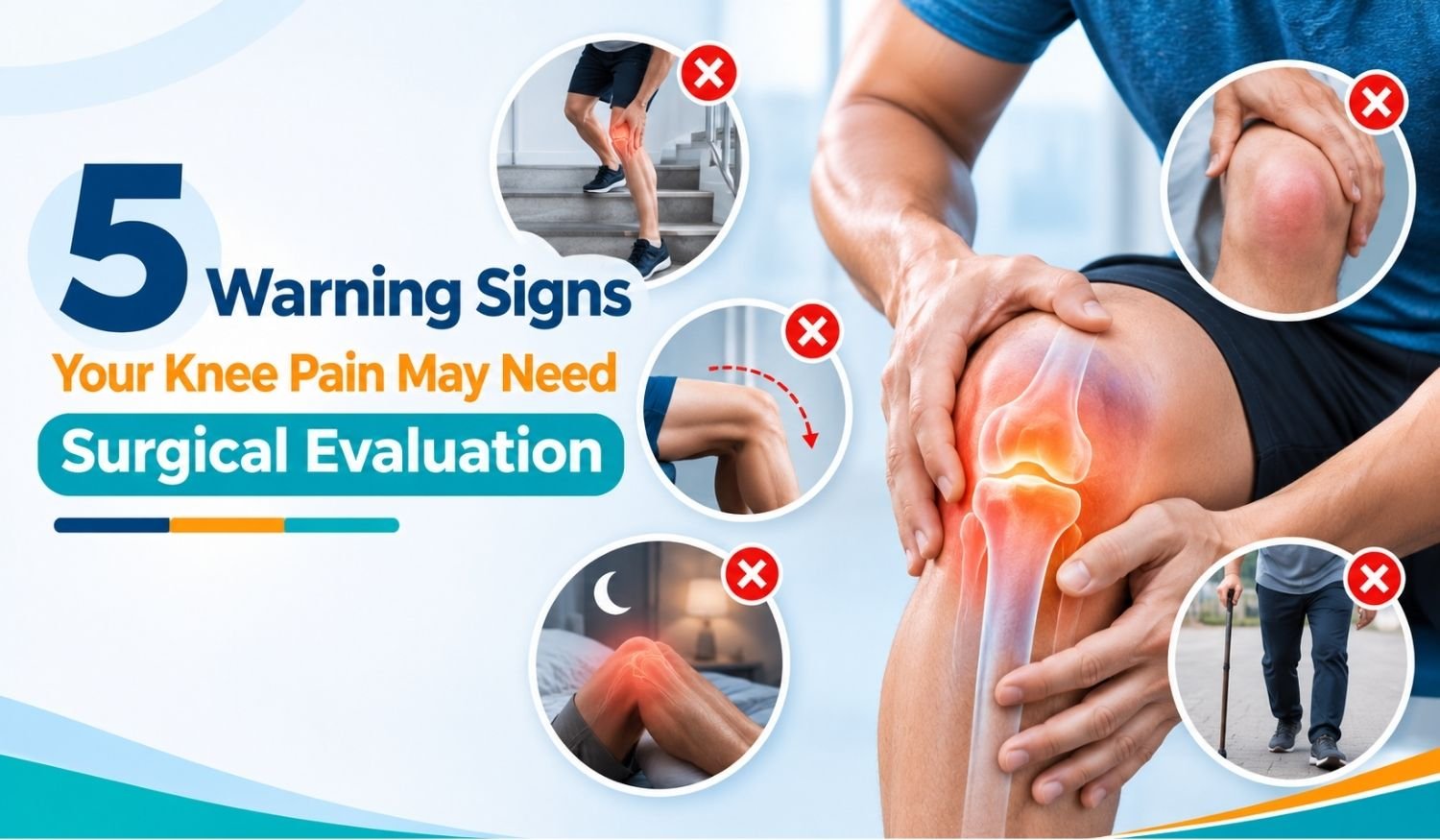
Most knee pain improves without surgery. But five warning signs mean you should be assessed by a doctor who can judge whether surgery is a realistic option: pain that keeps worsening despite proper non-surgical care, a knee that gives way, a knee that truly locks, deformity or inability to bear weight after an injury, and a hot, red, swollen knee with fever. The last two can be emergencies. A surgical evaluation is an assessment, not a decision to operate.
Quick Summary
- Surgery usually follows structured non-surgical care, except for injuries and infections.
- Clicking alone is not a surgical sign; true locking is different.
- Giving way deserves examination, especially after a twisting injury.
- A hot, red, swollen knee with fever needs same-day hospital assessment.
- An MRI finding alone does not decide treatment.
Introduction
Knee pain is one of the most common reasons people see a doctor, and common causes often improve without an operation. The harder question is when to stop waiting. This guide explains five warning signs that justify a surgical evaluation, which are urgent, and what to expect. It is general education, not a diagnosis.
How Urgent Is Each Warning Sign?
| Warning sign | Suggested urgency | What it may reflect (a doctor must confirm) |
| 1. Pain worsening despite proper non-surgical care | Book an assessment | Advanced osteoarthritis or structural damage |
| 2. Knee gives way | Prompt assessment; sooner after injury | Ligament injury, weak muscles, arthritis |
| 3. Knee truly locks | Prompt assessment, ideally within days | Displaced meniscus fragment, loose body |
| 4. Deformity, popping injury, cannot bear weight | Emergency care today | Fracture, dislocation, tendon rupture |
| 5. Hot, red, swollen knee with fever | Emergency care today | Joint infection (septic arthritis) |
Sign 1: Pain That Keeps Worsening Despite Proper Non-Surgical Care
Mayo Clinic and the NHS advise seeing a doctor when knee pain worsens, keeps returning, disturbs sleep or limits daily tasks. For knee osteoarthritis, AAOS guidance recommends supervised exercise, self-management education, sustained weight loss and anti-inflammatory medicines, and a 2023 Journal of Family Practice review places surgery after non-surgical treatment has failed.
“Proper” matters. Rest and tablets alone are not a trial. A real trial includes progressive thigh-muscle strengthening, weight management where relevant, activity pacing and follow-up. There is no universal timeline: patient pages quote 2–6 or 6–12 weeks, while NHS trust guidance suggests calling your GP if 3–4 weeks of self-help has not helped. Treat these as prompts for review, not deadlines for surgery.
Hypothetical example: a 62-year-old with knee arthritis who has only rested and taken tablets is likely best served by a structured rehabilitation trial and assessment, not an immediate operation.
Sign 2: Your Knee Gives Way
Mayo Clinic lists a knee that feels unstable or gives out among the reasons to call a doctor. Causes include ligament injury, weak thigh muscles and arthritis. Whether surgery helps depends on the cause and what you need your knee to do. Isolated grade 1–2 MCL sprains generally recover without surgery, and some people with an isolated ACL tear who stay stable in daily life can defer reconstruction, but most active patients and athletes need it to return to their previous level. Giving way after a twisting injury deserves assessment sooner rather than later.
Sign 3: Your Knee Truly Locks
Many people call clicking, catching or stiffness “locking”. True locking means the knee is physically blocked and cannot fully straighten, often because a torn meniscus piece or loose fragment is wedged in the joint. Mayo Clinic lists inability to fully extend or flex the knee as a reason to see a doctor, and the Journal of Family Practice review counts a locked knee among presentations that likely warrant surgical consultation.
Context matters. In degenerative meniscus tears in middle-aged and older adults, trials found arthroscopic surgery no better than exercise-based care or sham surgery; those trials excluded verified locked knees. Guidelines recommend against routine arthroscopy for degenerative tears and osteoarthritis. The distinction is catching or clicking (usually managed without surgery) versus a genuine mechanical block. Pain-related stiffness can mimic locking, so examination, and sometimes MRI, helps tell them apart.
Sign 4: Deformity, a Popping Injury or Inability to Bear Weight
After a fall, twist or collision, get urgent care if the knee looks misshapen, you heard a pop, pain is severe, swelling is sudden or you cannot stand on the leg. Mayo Clinic and the NHS list these as reasons for immediate help. Causes include fracture, kneecap dislocation, major ligament injury and tendon rupture. Some are time-sensitive: complete quadriceps or patellar tendon ruptures generally do best with early repair, and repair delayed beyond one to two weeks is associated with worse outcomes. A suspected knee dislocation with a pale, cold or numb foot is a vascular emergency. Slowly increasing bowing of the leg is different: it usually reflects long-standing arthritis and can be raised at a routine assessment.
Sign 5: A Hot, Red, Swollen Knee With Fever
A knee that is hot, red, swollen and very painful, especially with fever, chills or feeling unwell, needs assessment the same day. Mayo Clinic notes septic arthritis can quickly damage knee cartilage. The knee is the joint most often affected, and treatment usually involves draining the joint plus antibiotics. Fever is not present in everyone. Risk is higher after joint surgery or injections, with an artificial joint, or with a weakened immune system. Gout can look similar, so doctors confirm the cause from joint fluid.
What a Surgical Evaluation Involves
An evaluation is a structured assessment: your history, an examination of movement, swelling and stability, and usually an X-ray first, with MRI or CT only when they will change management. The outcome is often a non-surgical plan. For knee osteoarthritis, guidelines differ on injections: ACR guidance strongly recommends corticosteroid injections for short-term relief, conditionally recommends against hyaluronic acid and strongly recommends against PRP, while AAOS finds limited evidence for PRP. Some recent meta-analyses favour PRP. This disagreement is why choices should be individualised.
Myths vs Facts
| Myth | Fact |
| Clicking or popping means I need surgery. | Clicking alone is not a surgical sign. It matters alongside pain, swelling, giving way, true locking or a pop during injury. |
| A meniscus tear on MRI means an operation. | Degenerative tears are common, and trials show surgery is often no better than exercise-based care. Traumatic tears and true locking are exceptions. |
| If I have coped this long, I can keep waiting. | Infection, tendon rupture and dislocation are time-sensitive. |
Expert Insight
The useful question is rarely “surgery or no surgery”. It is “what is driving this pain, and has non-surgical care been tested properly?” Mayo Clinic notes that hip problems can refer pain to the knee, so the source is not always the joint itself.
Practical Action Plan
- Check the urgent signs first. Signs 4 and 5 mean emergency care today.
- Keep a two-week diary: night pain, stairs, giving way, locking, swelling and medicines used.
- Do a structured programme, not just rest: gradual strengthening, weight management if relevant and activity pacing.
- Book an assessment if pain has not improved after a few weeks, disturbs sleep or work, or you notice giving way or locking.
- Bring your records: earlier imaging reports and your medicine list.
Questions Patients Forget to Ask
- Does the imaging match my symptoms?
- Which non-surgical options have I not yet tried?
- What are the risks of waiting?
- If surgery is suggested, what happens without it?
Nexus Advanced Pain Management Expert Summary
Knee pain becomes a surgical question when function stays limited despite well-delivered non-surgical care, when the joint is mechanically blocked or unstable, or when an injury or infection is time-sensitive. The purpose of evaluation is clarity about the cause, options and trade-offs, so decisions are made calmly rather than by default. Signs 4 and 5 are not for waiting: seek emergency care.
How Nexus Advanced Pain Management Can Help
If your knee pain is persistent but no emergency sign applies, a pain assessment can clarify the likely source and what has and has not been tried. At Nexus Advanced Pain Management in Ahmedabad, care is built around:
- Comprehensive pain assessment: history, examination and review of existing imaging.
- Evidence-based, non-surgical treatment planning: exercise guidance, medication review and lifestyle support.
- Interventional procedures where they suit the diagnosis, discussed with realistic expectations.
- Rehabilitation and long-term pain management
- Clear advice on when an orthopaedic surgical opinion is appropriate.
Nexus Advanced Pain Management does not replace emergency care. Deformity, inability to bear weight, or a hot swollen knee with fever needs the nearest emergency department.
Key Takeaways
- Judge non-surgical care by its quality, not just its length.
- Giving way and true locking differ from clicking or catching.
- Deformity, inability to bear weight, or a hot, red knee with fever means emergency care today.
- Evaluation often ends in a non-surgical plan; it does not commit you to an operation.
Frequently Asked Questions
How do I know if my knee pain is serious?
Seek prompt care if you cannot bear weight, the knee looks deformed, swelling is sudden, you have fever with a red, hot knee, or pain disturbs sleep and daily tasks.
When should I see a doctor for knee pain?
See a doctor if pain is worsening, keeps returning, or has not improved after a few weeks of self-care. Go to an emergency department the same day for injury with deformity, inability to walk, or a hot, swollen knee with fever.
Does knee clicking or popping mean I need surgery?
No. Clicking alone is not a surgical sign. It deserves assessment with pain, swelling, giving way, true locking, or a pop during an injury.
Can a torn meniscus heal without surgery?
Many degenerative meniscus tears are managed with exercise-based care. Traumatic tears and a truly locked knee are different and need an orthopaedic opinion.
Can injections like PRP or steroids help me avoid surgery?
They may reduce pain in selected patients, but guidelines disagree on which injections to use. Discuss options for your specific diagnosis.
Should I see an orthopaedic surgeon or a pain specialist first?
Either can start the assessment. Injuries, locking or suspected structural damage usually need an orthopaedic opinion. For persistent arthritis-type pain, a pain specialist can review non-surgical options and advise when a surgical opinion is appropriate.