

Quick Answer
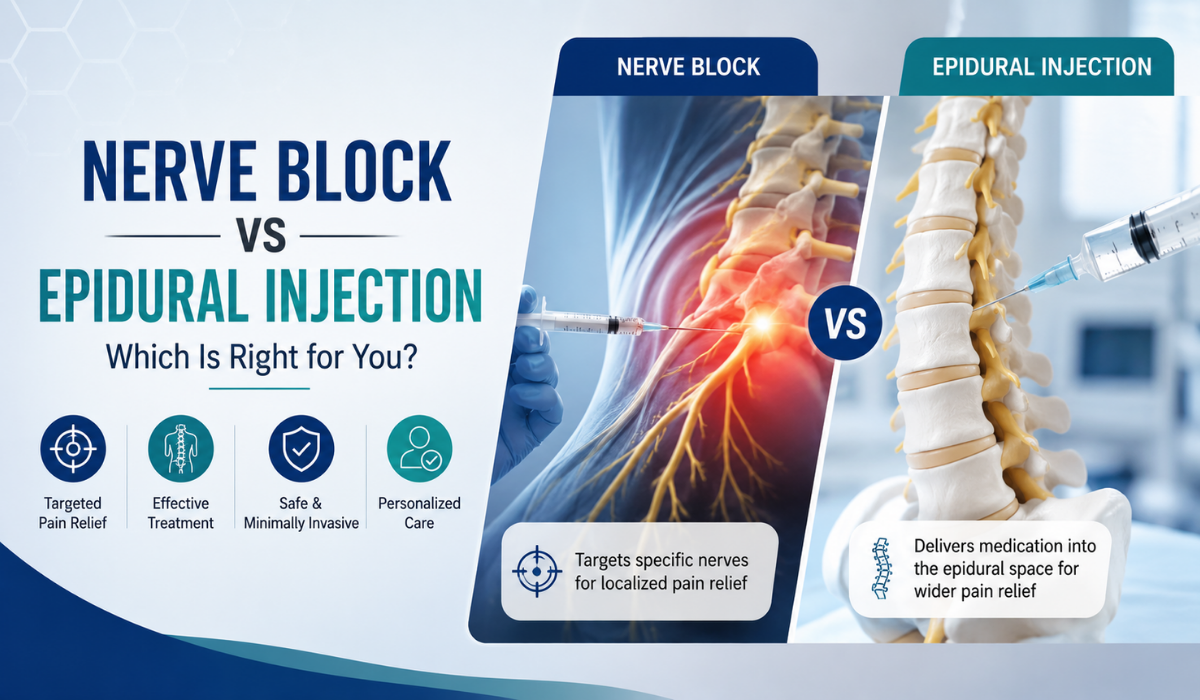
| An epidural injection delivers steroid medication into the epidural space to calm inflammation around multiple nerve roots — commonly used for sciatica, slip disc, and spinal stenosis. A nerve block targets one specific nerve directly, and is often used both to diagnose the exact source of pain and to treat localized nerve-related pain. The right choice depends on where your pain originates and what your imaging and clinical exam show, which is why an individual assessment by an interventional pain specialist matters more than the label of the procedure. |
Quick Summary
- Epidural injections treat a broader spinal segment; nerve blocks target one specific nerve.
- Both are minimally invasive, image-guided, outpatient procedures.
- Epidurals are typically used for disc-related and radicular pain (sciatica, slip disc, stenosis).
- Nerve blocks are used for localized nerve pain and as a diagnostic tool.
- Relief from either can last weeks to a few months and varies by patient.
- Neither procedure is inherently “better” — the right one depends on your diagnosis.
- Most patients resume normal light activity within 24–48 hours.
- A qualified interventional pain specialist should confirm suitability through clinical exam and imaging.
Introduction
If your doctor has mentioned an epidural injection or a nerve block for your back, neck, or leg pain, it’s natural to wonder which one actually applies to your situation. Both are well-established, non-surgical interventional pain procedures used across pain management practices, including here at Nexus Pain Management in Ahmedabad. But they are not interchangeable. Understanding what each procedure targets, how it works, and when a pain specialist typically recommends one over the other can help you have a more informed conversation at your next consultation.
What Is an Epidural Injection?
An epidural steroid injection delivers an anti-inflammatory steroid, often combined with a local anesthetic, into the epidural space — the area surrounding the spinal cord and the nerve roots as they exit the spine. By reducing inflammation around irritated nerve roots, an epidural can ease pain that radiates from the lower back into the leg (sciatica) or from the neck into the arm. Common types include interlaminar, transforaminal, and caudal epidural injections, each named for the specific approach used to reach the epidural space.
What Is a Nerve Block?
A nerve block delivers medication — typically a local anesthetic, sometimes combined with a steroid — directly around one specific nerve or a small group of nerves, rather than a broader spinal segment. Nerve blocks serve two purposes: diagnostic, to confirm whether a particular nerve is the true source of pain, and therapeutic, to reduce pain and inflammation at that nerve directly. Selective nerve root blocks, occipital nerve blocks, and stellate ganglion blocks are common examples used in interventional pain practice.
Conditions Each Procedure Typically Treats
| Aspect | Epidural Injection | Nerve Block |
| Target Area | Epidural space around multiple nerve roots | One specific nerve or nerve cluster |
| Common Conditions | Sciatica, slip disc, spinal stenosis, radiculopathy | Occipital neuralgia, post-surgical nerve pain, CRPS, focal neuropathic pain |
| Primary Purpose | Reduce inflammation, relieve radiating pain | Diagnose pain source and/or relieve localized nerve pain |
| Guidance Used | Fluoroscopy (X-ray) guided | Fluoroscopy or ultrasound guided |
| Typical Relief Duration | Several weeks to a few months | Hours (diagnostic) to weeks/months (therapeutic) |
| Procedure Time | 15–30 minutes | 10–20 minutes |
Symptoms That May Point to Either Procedure
- Pain radiating from the lower back down one or both legs
- Numbness, tingling, or weakness following a nerve pathway
- Neck pain radiating into the shoulder or arm
- Sharp, localized nerve pain triggered by movement or touch
- Chronic pain following a prior surgery or injury
Causes and Risk Factors
Radicular pain treated with epidurals is most often caused by a herniated or slipped disc, spinal stenosis, or degenerative changes compressing a nerve root. Localized nerve pain treated with nerve blocks can stem from nerve entrapment, post-surgical scarring, trauma, or conditions such as complex regional pain syndrome. Risk factors common to both include prolonged sitting, poor posture, repetitive strain, obesity, and age-related degenerative spine changes.
Diagnosis: How Your Specialist Decides
Choosing between a nerve block and an epidural is a clinical decision, not a patient preference alone. Your interventional pain specialist will review your symptom pattern, physical examination findings, and imaging (MRI or CT) to identify whether pain originates from a broad nerve root compression (favoring an epidural) or a single identifiable nerve (favoring a nerve block). In some cases, a diagnostic nerve block is used first, purely to confirm the exact pain generator before deciding on the next step.
Non-Surgical Treatment Approach
Both procedures fall under non-surgical, interventional pain management — an approach that aims to relieve pain and improve function without surgery. They are typically considered after conservative measures such as physiotherapy, activity modification, and oral medication have provided limited relief, and before surgery is discussed. Many patients combine these injections with a structured rehabilitation plan for longer-term benefit.
| Expert Insight “Patients often ask us which procedure is ‘stronger.’ That’s the wrong question. An epidural and a nerve block are designed for different pain patterns. The real work is in pinpointing exactly where the pain is coming from — that’s what determines the right procedure, not which one sounds more advanced.” — Nexus Pain Interventional Team |
Recovery and Rehabilitation
Recovery from both procedures is typically quick. Most patients rest briefly after the injection, are monitored for a short period, and are able to go home the same day. Mild soreness at the injection site for a day or two is common. Specialists usually recommend avoiding strenuous activity for 24 to 48 hours, after which normal daily activity can gradually resume. Pain relief is often not immediate — it may take a few days to a week to notice the full effect, particularly with steroid-based injections.
| Expert Insight “One of the most common mistakes we see is patients expecting instant, permanent relief from a single injection. These procedures are one part of a broader pain management plan, not a standalone cure.” — Nexus Pain Interventional Team |
Common Mistakes Patients Make
- Assuming both procedures treat the same conditions and asking for one by name without a proper evaluation.
- Expecting permanent relief from a single injection rather than viewing it as part of a broader treatment plan.
- Skipping the physiotherapy or rehabilitation phase that supports and extends the benefit of the injection.
Myths vs Facts
| Myth | Fact |
| A nerve block is always weaker than an epidural. | Effectiveness depends on whether the pain source is localized or spread across a nerve root region, not on the procedure name. |
| These injections are only used as a last resort before surgery. | They are often used earlier in a treatment plan, alongside physiotherapy, once conservative care alone hasn’t given enough relief. |
| Epidural injections and spinal anesthesia are the same thing. | They use similar anatomy but serve very different purposes — one manages chronic pain, the other is for surgical anesthesia. |
| More injections always mean better results. | Response is individual; some patients improve significantly with one injection, while repeat injections beyond a certain point may add limited additional benefit. |
| Expert Insight “We always explain the ‘why’ behind the choice of procedure. When patients understand that a nerve block versus an epidural is a targeting decision — not a strength ranking — they make more confident, informed choices about their care.” — Nexus Pain Interventional Team |
Questions Patients Forget to Ask
- How will we confirm this procedure is targeting the actual source of my pain?
- What should I expect to feel in the first 48 hours after the injection?
- How many injections might I realistically need, and how will we decide to stop?
- What non-injection options should run alongside this treatment?
- At what point would we consider this approach isn’t working and revisit the plan?
Practical Action Plan
- Book a consultation with an interventional pain specialist and bring any existing MRI, X-ray, or CT reports.
- Ask your specialist to explain, in your specific case, why a nerve block, an epidural, or another approach is being recommended.
- Clarify expected timelines: when relief should begin, how long it may last, and what follow-up is planned.
- Plan for 24–48 hours of lighter activity after the procedure, and arrange transport if advised.
- Pair the procedure with a physiotherapy or rehabilitation plan for longer-term pain management.
Nexus Pain Expert SummaryBoth nerve blocks and epidural injections are established, minimally invasive tools in non-surgical pain management. Neither is universally superior — the right choice depends on precisely where your pain originates, confirmed through clinical examination and imaging. At Nexus Pain Management, our approach starts with a comprehensive assessment before recommending either procedure, ensuring the treatment plan matches your specific diagnosis rather than a generic protocol. |
Key Takeaways
- Epidural injections target the broader epidural space around nerve roots; nerve blocks target one specific nerve.
- Epidurals are typically used for sciatica, slip disc, and spinal stenosis-related pain.
- Nerve blocks are used for localized nerve pain and to diagnose the exact pain source.
- Both are outpatient, image-guided, and generally allow same-day discharge.
- Relief duration varies by patient and by whether the block is diagnostic or therapeutic.
- The decision should be made by a specialist after clinical exam and imaging — not chosen by the patient alone.
- Combining either procedure with physiotherapy typically supports longer-lasting results.
How Nexus Pain Can Help
Nexus Pain Management provides comprehensive pain assessment and evidence-based, non-surgical treatment planning for patients across Ahmedabad. Our interventional pain specialists use image-guided techniques — including epidural injections and nerve blocks — as part of a personalized treatment plan that also considers rehabilitation guidance and long-term pain management strategies. Every recommendation is based on individual clinical evaluation rather than a one-size-fits-all protocol, with the goal of helping patients understand their options and make informed decisions about their care.
FAQ Section
1. Is a nerve block the same as an epidural injection?
No. Both are injection-based pain treatments, but an epidural places medication into the epidural space surrounding multiple nerve roots along the spine, while a nerve block targets one specific nerve or a small nerve cluster. They serve overlapping but distinct purposes.
2. Which is more effective, a nerve block or an epidural?
Neither is universally “better.” Epidurals tend to work well for broad radicular pain from disc herniation or spinal stenosis affecting a spinal segment. Nerve blocks are often more effective when pain is traced to one identifiable nerve, such as occipital neuralgia or post-surgical nerve pain.
3. How long does pain relief from a nerve block last compared to an epidural?
Diagnostic nerve blocks with local anesthetic may relieve pain for hours; therapeutic blocks with steroid can last weeks to months. Epidural steroid injections typically provide relief for several weeks up to a few months, and effects vary by patient and underlying condition.
4. Can nerve blocks and epidural injections be used together in a treatment plan?
Yes. A pain specialist may use a diagnostic nerve block first to confirm the exact pain source, then follow with an epidural or a targeted procedure such as radiofrequency ablation based on the response.
5. Are nerve blocks or epidural injections painful?
Both procedures involve a brief needle insertion under local anesthetic and image guidance, so most patients report mild discomfort rather than significant pain. Some pressure or a brief stinging sensation during the injection is common.
6. How many injections are typically needed?
This depends on the condition and response. Some patients experience meaningful relief from a single injection, while others require a short series spaced weeks apart, always guided by how the body responds rather than a fixed number.
7. What conditions are epidural injections used for?
Epidural steroid injections are commonly used for sciatica, herniated or slipped disc, spinal stenosis, and radiculopathy where inflammation around a nerve root is contributing to pain radiating into the arm or leg.
8. What conditions are nerve blocks used for?
Nerve blocks are used for localized nerve pain such as occipital neuralgia, intercostal nerve pain, complex regional pain syndrome, post-surgical nerve pain, and as a diagnostic tool to confirm a specific pain generator.
9. Is one procedure safer than the other?
Both are considered safe, minimally invasive, image-guided procedures when performed by a trained interventional pain specialist. Every injection carries some risk, including infection, bleeding, or temporary soreness, which your specialist will review with you beforehand.
10. Do I need surgery if injections don’t work?
Not necessarily. If injections provide limited or short-lived relief, your specialist may recommend additional non-surgical options such as radiofrequency ablation, physiotherapy-led rehabilitation, or a revised treatment plan before surgery is even discussed.
11. How soon can I return to work after a nerve block or epidural injection?
Most patients resume light daily activities the same day or the next day, though your specialist may recommend avoiding strenuous activity for 24 to 48 hours depending on the injection site and your individual recovery.
12. Can I get a nerve block or epidural injection in Ahmedabad without traveling elsewhere?
Yes, image-guided nerve blocks and epidural injections are available locally through interventional pain management clinics in Ahmedabad, so patients do not need to travel to other cities for these procedures.