

Quick Answer
PRP recovery does not follow one fixed schedule for everyone. After a platelet-rich plasma injection, some people experience temporary soreness, swelling or stiffness before symptoms gradually improve. Recovery can take several weeks or longer depending on the condition treated, the tissue involved and the rehabilitation plan.
A useful general framework is to think about recovery in stages: the first few days focus on protecting the treated area, the following weeks involve gradual movement and rehabilitation, and later stages focus on progressive strengthening and return to normal activities.
Quick Summary
- Mild soreness, swelling or bruising can occur after PRP.
- The first week is generally focused on protecting the treated area.
- Activity should usually increase gradually rather than immediately returning to strenuous exercise.
- Rehabilitation may become an important part of recovery.
- Improvement may take several weeks, particularly for musculoskeletal conditions.
- Tendon, muscle and joint problems can have different recovery patterns.
- A temporary change in pain does not by itself determine whether PRP has worked.
- Your treating clinician’s instructions should take priority over a generic timeline.
Introduction
Platelet-rich plasma, commonly called PRP, is an injection prepared from a patient’s own blood. Platelets are concentrated and then delivered to a targeted area with the aim of supporting the body’s healing response. PRP is used in several musculoskeletal conditions, although evidence and expected outcomes vary depending on the condition being treated.
One of the most common questions after treatment is: “What should I expect each week?”
The answer is more nuanced than a simple countdown. PRP recovery is influenced by the treated tissue, the underlying condition, the injection approach and the rehabilitation programme. The timeline below is therefore a general framework rather than a promise of when a particular patient will recover.
What Happens After a PRP Injection?
The injection introduces concentrated platelets into the treatment area. These platelets contain biological substances involved in tissue repair and healing. However, the exact mechanism and clinical effect of PRP are not completely understood, and results can differ between conditions.
Some patients experience temporary discomfort after the injection. Soreness, swelling or bruising around the injection site can occur.
This early period should not be interpreted as the final treatment result.
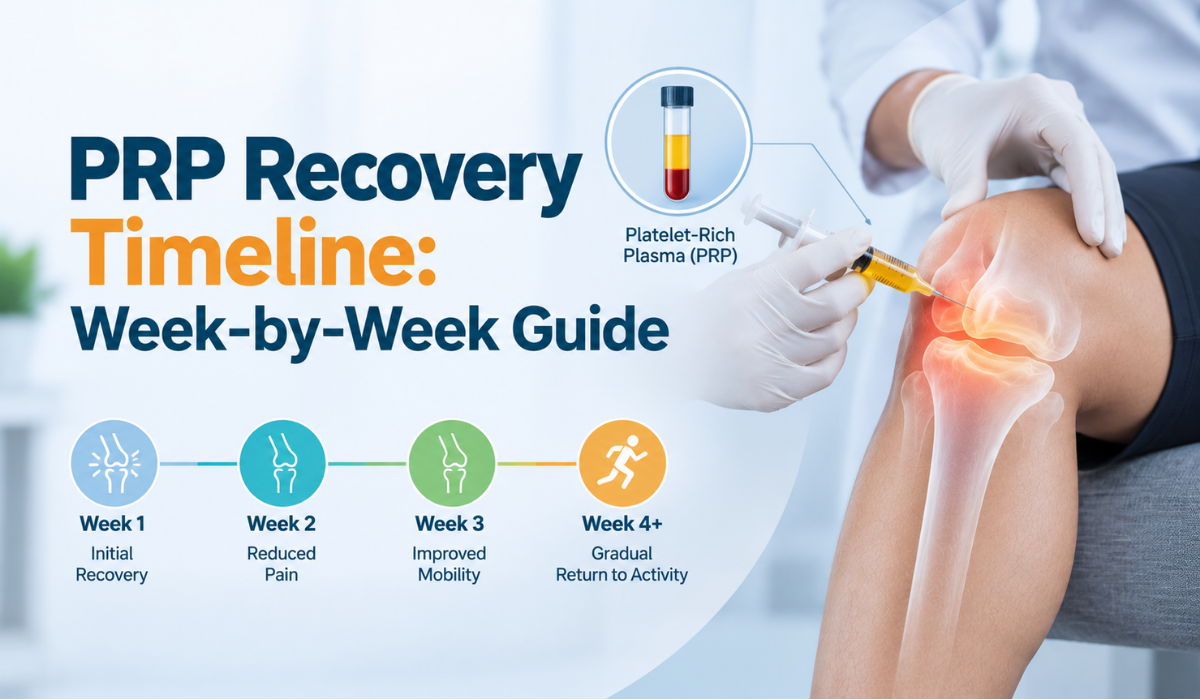
PRP Recovery Timeline: Week by Week
| Recovery period | What may happen | General focus |
| Days 1–3 | Soreness, swelling or tenderness may occur | Protect the treated area |
| Week 1 | Early discomfort may gradually settle | Gentle movement as advised |
| Weeks 2–4 | Function may gradually improve | Begin or progress rehabilitation |
| Weeks 4–8 | Strength and activity may gradually increase | Progressive loading |
| Week 8+ | Further improvement may occur | Gradual return to higher activity |
Days 1–3: Initial Recovery
The first few days are often focused on managing the immediate effects of the injection. You may notice local soreness, mild swelling, tenderness, bruising or temporary stiffness. During this period, avoid assuming that feeling better or worse means the treatment has succeeded or failed. Early symptoms are not a reliable measure of the eventual result. Follow the activity and medication instructions provided by your treating clinician.
Week 1: Protecting the Treated Area
During the first week, the goal is generally to avoid unnecessary stress on the treated tissue while maintaining appropriate movement. Depending on the treatment site, your clinician may recommend gentle movement or range-of-motion exercises. However, strenuous exercise, heavy lifting or high-impact activity may need to be restricted temporarily. Do not copy another patient’s PRP protocol simply because they received treatment for a similar problem.
Weeks 2–4: Gradual Return to Movement
As early discomfort settles, rehabilitation may become more important. Depending on the condition, this stage may involve gentle mobility exercises, gradual walking or daily activity, range-of-motion work, isometric exercises, supervised physical therapy and controlled strengthening. The key principle is progressive loading rather than sudden loading.
Weeks 4–8: Progressive Rehabilitation
For many musculoskeletal conditions, recovery continues beyond the initial few weeks. If your clinician considers the treated tissue ready, rehabilitation may progress toward greater resistance, improved strength, better movement control, increased activity tolerance and condition-specific exercises. This stage should be based on functional progress rather than the calendar alone.
Week 8 and Beyond: Returning to Higher Activity
Some patients may continue to improve beyond eight weeks. The timing of a return to running, sport, heavy resistance training or other demanding activities depends on the original diagnosis and the tissue treated. Therefore, week 8 should not be treated as an automatic clearance date. A safer approach is to progress activity when symptoms, function, strength and clinical assessment indicate that the tissue is ready.
What Affects PRP Recovery Time?
- The condition being treated — different conditions respond differently to PRP.
- The tissue involved — tendon, muscle, ligament and joint problems have different biological and functional demands.
- Severity of the problem — more significant tissue damage may require longer rehabilitation.
- Rehabilitation — the right progression of exercises can be an important part of recovery.
- Overall health and activity level — individual patient factors can influence recovery.
- PRP preparation and treatment protocol — PRP is not one standardized product or procedure.
For this reason, online recovery timelines should be used for general education rather than as personal medical instructions.
What Should You Avoid After PRP?
Your clinician’s instructions should take priority, but patients are commonly advised to avoid activities that place excessive stress on the treated area during the early recovery period. Depending on the treatment, this may include:
- High-impact exercise
- Heavy lifting
- Aggressive stretching
- Returning immediately to competitive sport
- Activities that significantly aggravate symptoms
Medication advice can also vary. Some clinicians recommend avoiding NSAIDs because of concerns about their effects on the inflammatory response, while protocols differ between practices. Do not start, stop or change medication without discussing it with your healthcare provider.
When Should You Contact Your Doctor?
Contact your healthcare provider if you develop symptoms that are unexpected, severe or progressively worsening. Particular attention is warranted for:
- Severe or increasing pain
- Significant swelling
- Fever
- Increasing redness or warmth
- Drainage from the injection site
- New weakness, numbness or neurological symptoms
- Any other symptom that concerns you
PRP injections are generally considered to have a relatively low risk of serious complications, but bleeding, infection, tissue damage and nerve injury are recognized risks.
How Rehabilitation Supports PRP Recovery
PRP should not automatically be viewed as a standalone solution. For many musculoskeletal conditions, the treatment plan may combine the injection with activity modification and rehabilitation. The purpose is not simply to wait for the injection to work but to progressively restore appropriate movement, strength and function.
The right rehabilitation programme depends on the diagnosis.
Expert insight: The most useful question is often not “What week am I in?” but “Has my function improved enough to safely progress?” This allows activity to be adjusted according to actual recovery rather than an arbitrary calendar date.
Nexus Advanced Pain Management Expert Summary
PRP recovery is best understood as a gradual process rather than a fixed week-by-week guarantee. Temporary soreness or swelling can occur after treatment, while meaningful improvement may take several weeks or longer depending on the condition and tissue treated.
Patients should avoid judging treatment success too early and should follow the rehabilitation plan provided by their healthcare professional.
Most importantly, recovery should be guided by the diagnosis, symptoms, functional progress and clinical assessment—not simply by the number of weeks since the injection.
How Nexus Advanced Pain Management Can Help
At Nexus Advanced Pain Management, PRP treatment can be considered as part of an individualized pain-management approach when clinically appropriate.
A professional assessment can help determine whether PRP is relevant to the underlying condition, what other treatment options may be appropriate, and how activity or rehabilitation should be progressed after treatment.
The focus should remain on understanding the source of pain, selecting an appropriate treatment strategy and monitoring recovery over time.
Key Takeaways
- PRP recovery does not follow one identical timeline for every patient.
- Early soreness, tenderness or swelling can occur after an injection.
- The first week generally requires protection of the treated area.
- Activity should usually progress gradually.
- Rehabilitation may play an important role in restoring function.
- Tendon, muscle and joint treatments can have different recovery patterns.
- Improvement may take several weeks or longer.
- Do not use a generic online timeline as personal medical clearance.
- Contact your healthcare provider if symptoms are severe, worsening or concerning.
- Your treating clinician’s post-PRP instructions should take priority.
Frequently Asked Questions
How long does PRP take to work?
There is no universal timeframe. Results can become noticeable after several weeks for some joint applications, while the overall response depends on the condition and treatment area.
Is pain normal after a PRP injection?
Some soreness, tenderness or bruising can occur after PRP. However, severe or progressively worsening pain should be discussed with your healthcare provider.
Can I exercise after PRP?
Activity restrictions vary according to the treated condition and tissue. High-impact or strenuous activity is commonly limited during early recovery, followed by gradual rehabilitation when appropriate.
When can I return to sports after PRP?
There is no universal return-to-sport date. It depends on the injury, symptoms, strength, functional progress and rehabilitation plan.
Does PRP recovery take longer for tendon problems?
It can. Tendons and other tissues have different healing and loading characteristics, so recovery should be individualized rather than based on a single standard timeline.
Should I take anti-inflammatory medicines after PRP?
Medication instructions vary. Some PRP protocols recommend avoiding NSAIDs because of their potential effects on inflammation, but you should follow the specific instructions given by your treating clinician.
What happens if I feel better after only one week?
Early improvement does not necessarily mean that tissue recovery is complete. Continue following the recommended rehabilitation and activity progression.
When should I contact my doctor after PRP?
Seek medical advice if you experience severe or worsening pain, significant swelling, fever, increasing redness, drainage, new neurological symptoms or another concerning change.