

Quick Answer
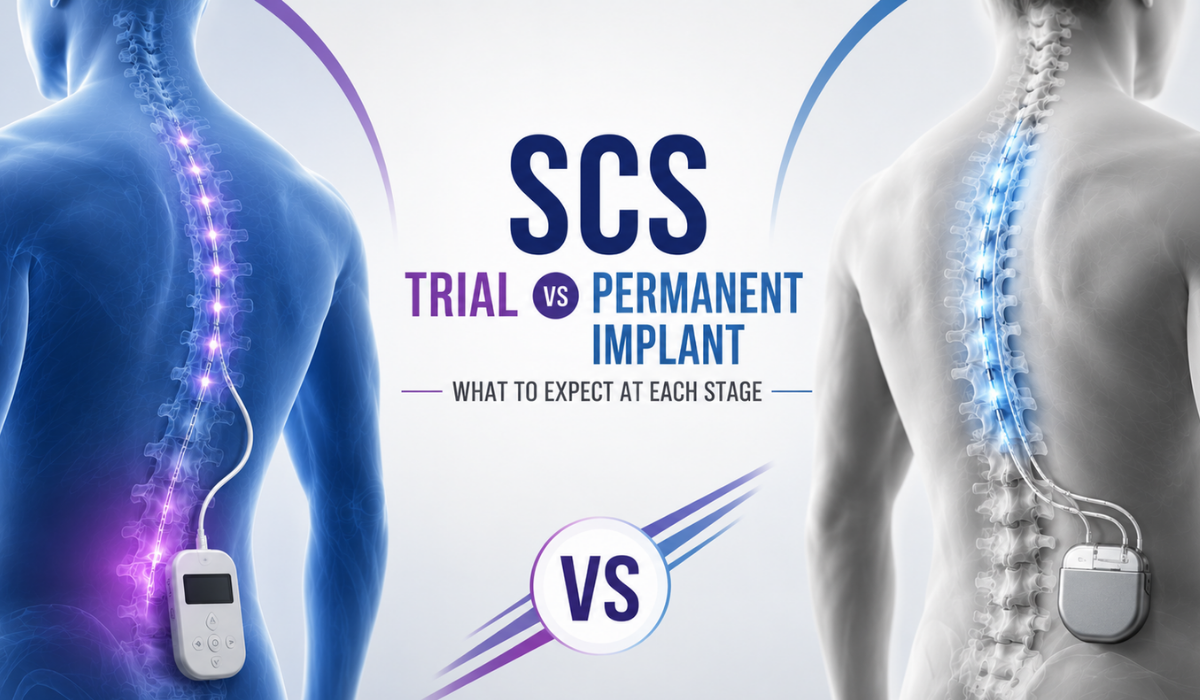
An SCS trial is a short, fully reversible test: thin leads are placed near the spinal cord for 3–7 days to see whether stimulation reduces pain by roughly half or more. Only after a successful trial does a patient move to the permanent implant — a same-day procedure that places a small pulse generator under the skin along with permanent leads. The trial answers “will this work for me?”; the permanent implant is the long-term solution.
Quick Summary
- The SCS trial and the permanent implant are two separate, staged procedures — not one surgery.
- The trial uses temporary leads connected to an external stimulator worn on a belt, typically for 3–7 days.
- A trial is generally considered successful when pain reduces by about 50% or more, along with better daily function.
- If the trial doesn’t help enough, the temporary leads are removed in-clinic — no permanent device is implanted.
- The permanent implant procedure usually takes about 1–2 hours and is often done as a day-care or short-stay procedure.
- Recovery after the trial is quick; recovery after the permanent implant involves restricted bending, twisting, and lifting for several weeks while the leads anchor.
- Both stages use fluoroscopic (X-ray) guidance for precise, minimally invasive lead placement.
Introduction
When a patient’s chronic pain hasn’t responded well to medications, physiotherapy, or interventional procedures such as transforaminal blocks or radiofrequency ablation, spinal cord stimulation (SCS) is often discussed as the next option. What confuses many patients is that SCS isn’t a single surgery — it’s a two-stage process. The first stage, the trial, lets both the patient and the treating team see whether stimulation actually helps before committing to a permanent device. The second stage, the permanent implant, is only offered once the trial has shown meaningful benefit. Understanding what happens — and what’s expected of you — at each stage makes the decision far less daunting.
Who Is Typically a Candidate for SCS
Spinal cord stimulation is generally considered for chronic pain conditions that have not responded adequately to conservative and interventional treatments, including:
- Failed back surgery syndrome (persistent pain after spine surgery)
- Chronic radicular pain in the leg or arm (sciatica-type nerve pain)
- Complex regional pain syndrome (CRPS)
- Certain forms of peripheral neuropathic pain
- Chronic low back and leg pain not adequately controlled by non-surgical treatment
Why the Trial Always Comes Before the Permanent Implant
Response to spinal cord stimulation varies considerably from person to person — the same settings that bring strong relief for one patient may do very little for another. The trial functions as a low-risk “test drive.” It lets the patient experience real stimulation in daily life for several days, and lets the physician fine-tune lead position and programming, before anyone commits to a permanent implant. This staged approach exists specifically to avoid permanent surgery for patients who are unlikely to benefit.
Risk Factors and Precautions to Discuss Beforehand
Not every patient is an equally straightforward candidate, and certain factors call for extra caution or a modified plan:
- Active infection anywhere in the body at the time of the procedure
- Bleeding disorders or ongoing blood-thinning medication that needs to be managed beforehand
- Poorly controlled diabetes, which can affect wound healing and infection risk
- Pregnancy
- Inability to safely operate the external trial device or the permanent remote control
- Unrealistic expectations about what stimulation can and cannot achieve
How Candidacy Is Determined
Before recommending a trial, the pain specialist typically carries out a comprehensive pain assessment, reviews prior treatments already tried, examines relevant imaging, and discusses the patient’s goals and expectations in detail. Some patients also undergo a brief psychological screening, since emotional readiness and realistic expectations are strongly linked to how satisfied patients are with the outcome. This work-up is what determines whether a trial is appropriate at all.
Stage 1: The SCS Trial — What to Expect
The trial is performed as an outpatient, minimally invasive procedure:
- You’ll have a consultation to confirm candidacy and go over consent, risks, and goals.
- On the day of the procedure, local anesthesia with light sedation is used — you remain comfortable but can give feedback.
- Positioned face-down, thin percutaneous leads are guided into the epidural space near the spinal cord under fluoroscopic (X-ray) guidance.
- Stimulation is tested during the procedure to map where you feel the tingling (paresthesia) sensation, confirming it covers your pain area.
- The leads are secured externally and connected to a small external stimulator worn in a pouch on your belt.
- You go home the same day with clear instructions: avoid bending, twisting, or lifting; keep the dressing dry; and don’t drive while the external device is connected.
- Over the next 3–7 days, you track your pain and function — sleep, walking distance, medication use — often in a simple diary.
- A follow-up visit reviews the results together and decides on next steps.
Stage 2: The Permanent Implant — What to Expect
The permanent implant is scheduled only after a successful trial, and follows a similar but more complete process:
- The procedure is usually done as a day-care or short-stay case, under local anesthesia with sedation or, in some cases, general anesthesia.
- Permanent leads are placed at the same or a very similar spinal level as the trial, again under fluoroscopic guidance.
- A small pocket is created under the skin — commonly in the upper buttock or abdominal area — to house the implantable pulse generator (IPG).
- The leads are tunneled under the skin and anchored in place to reduce the chance of movement over time.
- Stimulation is tested again during the procedure before the incisions are closed.
- The entire procedure typically takes about 1–2 hours, and most patients go home the same day or after a short overnight observation.
- The device is switched on and programmed by your physician in the days following surgery, and you’re given a remote to adjust settings within a range they set.
Trial vs Permanent Implant: Side-by-Side Comparison
| Aspect | SCS Trial | Permanent Implant |
| Purpose | Test whether stimulation relieves your pain | Long-term pain management |
| Leads | Temporary, percutaneous | Permanent, anchored |
| Generator | External, worn on a belt | Implanted under the skin |
| Typical procedure time | 30–45 minutes | 1–2 hours |
| Hospital stay | Day-care, no admission | Day-care or short overnight stay |
| Duration of use | 3–7 days | Years (battery life dependent) |
| Reversibility | Fully reversible — leads simply removed | Removable, but a more involved procedure |
| Activity restriction | A few days | Roughly 4–6 weeks |
| Next step if successful | Proceed to permanent implant | Long-term follow-up and reprogramming |
Preparing for Each Stage
Before the trial:
- Confirm with your physician which medications (especially blood thinners) need to be paused, and for how long.
- Keep blood sugar well controlled in the days beforehand if you’re diabetic.
- Arrange help at home, since bending and lifting will be restricted.
- Wear loose, comfortable clothing that makes room for the external device pouch.
Before the permanent implant:
- Review your trial diary with your physician so the decision is based on objective data, not memory alone.
- Plan time off work — most patients need at least a few days, sometimes longer depending on job demands.
- Arrange a ride home, since you won’t be able to drive immediately after sedation or anesthesia.
- Avoid smoking in the lead-up to surgery, as it can slow wound healing.
Recovery and Rehabilitation
Recovery after the trial is minimal — most patients simply avoid strenuous activity and keep the insertion sites dry until the leads are removed. Recovery after the permanent implant needs more care: gentle walking is usually encouraged early on, but bending, twisting, reaching overhead, and heavy lifting are typically restricted for around 4–6 weeks while the leads settle into position and scar tissue forms around the anchor points. Follow-up visits during this period are used to fine-tune programming as swelling resolves and your body adjusts to the device. Some patients benefit from light physiotherapy afterward to support the muscles around the implant site once cleared by their physician.
Expert Insight
Expert Insight 1: A successful trial is judged on more than a pain score. Improvements in sleep, walking tolerance, and reduced reliance on pain medication matter just as much as the percentage of pain relief — and are usually better predictors of long-term satisfaction.
Expert Insight 2: Because permanent leads are actively anchored during the implant surgery — unlike the temporary fixation used in the trial — the risk of lead migration drops meaningfully after this stage, provided activity restrictions are followed during the initial healing weeks.
Expert Insight 3: Spinal cord stimulation is designed to reduce pain and improve function — it is not positioned as a cure. Patients who go into the trial with a clear, realistic goal (for example, walking further or sleeping through the night) tend to have a more accurate read on whether the therapy is working for them.
Common Mistakes Patients Make
- Judging the trial purely by a pain number and ignoring functional changes like sleep quality, walking distance, or medication use.
- Becoming too active too soon after the permanent implant, which raises the risk of lead migration before the anchor points have settled.
- Not keeping a simple daily diary during the trial, which makes it harder to have an objective, data-based conversation at the follow-up visit.
Myths vs Facts
| Myth | Fact |
| The trial basically is the surgery, so if it works, the permanent implant is automatic. | The permanent implant is a separate decision, made only after reviewing your trial diary and functional results together with your physician. |
| The permanent implant is major open spine surgery. | It’s typically a minimally invasive, percutaneous procedure with a small pocket incision — usually done as a day-care or short-stay case. |
| Once implanted, the settings are fixed. | Programming can be adjusted at follow-up visits, and many devices allow patients to fine-tune within a safe range using a handheld remote. |
| SCS eliminates pain completely. | The realistic goal is meaningful, sustained pain reduction and better function — commonly around 50% or more — not total elimination of pain. |
Questions Patients Often Forget to Ask
- What level of pain reduction would count as a “successful” trial for my specific situation?
- Which activities should I avoid during the trial versus after the permanent implant?
- Who do I contact if my settings need adjusting after I go home?
- What is the expected battery life of the device, and what happens when it needs replacing?
- Are there any MRI compatibility considerations with the specific device being used?
- What is the plan if the trial shows partial but not quite sufficient relief?
Practical Action Plan
- Book a consultation for a comprehensive pain assessment and treatment history review.
- Confirm that conservative and interventional options have already been tried without adequate relief.
- Discuss trial logistics — timing, help at home, and time away from work.
- Undergo the SCS trial and track pain and function daily.
- Review the results with your pain specialist to decide on the permanent implant.
- If proceeding, plan the permanent implant date along with post-procedure recovery support.
- Attend follow-up visits for device programming and long-term management.
Nexus Pain Expert Summary
The SCS trial and the permanent implant are two distinct, deliberately staged steps. The trial exists to protect patients from undergoing permanent surgery without evidence that stimulation will genuinely help them. A thoughtful work-up, an honestly tracked trial period, and realistic expectations at each stage are what most reliably lead to a good long-term outcome.
How Nexus Pain Can Help
For patients exploring whether spinal cord stimulation is appropriate for their pain, Nexus Advanced Pain Management offers a comprehensive pain assessment that reviews prior treatments, relevant imaging, and realistic goals before any trial is discussed. Care is built around evidence-based, staged decision-making — starting with non-surgical and interventional options, and considering neuromodulation only when appropriate. Where a trial and permanent implant are pursued, personalized treatment planning, careful post-procedure guidance, and long-term follow-up support patients through recovery and device management.
Key Takeaways
- SCS is a two-stage process — a reversible trial, followed by a permanent implant only if the trial succeeds.
- A trial is typically judged successful with about 50% or more pain reduction plus improved function.
- The trial is fully reversible; the permanent implant requires more deliberate planning and recovery time.
- Both stages use fluoroscopic guidance and are generally minimally invasive.
- Recovery after the permanent implant needs roughly 4–6 weeks of activity restriction while leads anchor.
- Programming can be adjusted after implantation — it isn’t a fixed, one-time setting.
- Candidacy is based on a full pain history, prior treatments tried, and realistic goal-setting, not on the SCS device alone.
Frequently Asked Questions
What is the main difference between an SCS trial and a permanent implant?
The trial uses temporary leads and an external stimulator for a few days to test whether stimulation helps; the permanent implant places a small device fully under the skin for long-term use, and is only done after a successful trial.
How long does the SCS trial period last?
Most trials run for about 3 to 7 days, though your physician may adjust this based on your response and schedule.
Is the SCS trial painful?
The trial is done under local anesthesia with light sedation, so most patients tolerate it well with only mild discomfort at the insertion site afterward.
What happens if the SCS trial doesn’t relieve my pain?
If relief isn’t meaningful, the temporary leads are simply removed in the clinic — this is a low-risk step, and no permanent device is implanted.
How soon after a successful trial can the permanent implant be done?
This varies by clinic and patient factors, but it’s typically scheduled within a few weeks of a successful trial, once results are reviewed.
Is the permanent implant surgery major surgery?
It’s generally a minimally invasive, percutaneous procedure done as a day-care or short-stay case — not open spine surgery.
How long is the recovery after the permanent SCS implant?
Most patients are asked to limit bending, twisting, and heavy lifting for roughly 4 to 6 weeks while the leads anchor and the incision heals.
Can I drive during the trial period?
No — most physicians advise against driving while the external trial device and dressing are in place; this is reassessed once the trial ends.
Will I need to stay in the hospital for the permanent implant?
Most patients go home the same day, though some are kept for a short overnight observation depending on their overall health and the surgical plan.
Can the SCS settings be adjusted after implantation?
Yes — programming can be fine-tuned at follow-up visits, and many patients are given a remote to make limited adjustments within a safe range.
Are there risks specific to the permanent implant that don’t apply to the trial?
Yes — because the device is fully implanted, risks like infection at the generator pocket and lead migration are managed differently and call for the longer activity-restriction period.
What conditions are typically treated with spinal cord stimulation?
Common indications include failed back surgery syndrome, chronic radicular leg or arm pain, complex regional pain syndrome, and certain neuropathic pain conditions that haven’t responded to other treatments.
How is candidacy for SCS determined?
Through a comprehensive pain assessment, review of previously tried treatments, relevant imaging, and a discussion of goals and expectations — sometimes alongside a brief psychological screening.
Can the permanent device be removed later if needed?
Yes, it can be removed if medically necessary, though this is a more involved procedure than removing the temporary trial leads.
Where can I get evaluated for an SCS trial in Ahmedabad?
An interventional pain specialist can review your pain history and prior treatments to determine whether a trial is appropriate for you.