

Quick Answer
Complex Regional Pain Syndrome (CRPS) is traditionally described in three progressive stages — acute (warm), dystrophic, and atrophic — marked by escalating pain, skin and temperature changes, stiffness, and eventually irreversible tissue and bone changes if left untreated. Not every patient moves through all three stages in the same way, but the general pattern is that the earlier CRPS is diagnosed and treated, the better the chances of controlling pain and preserving limb function.
Quick Summary
- CRPS most often follows an injury, fracture, surgery, or nerve damage to an arm or leg.
- Clinicians commonly describe three stages: acute, dystrophic, and atrophic — though real-world progression varies from person to person.
- Early symptoms include burning pain, swelling, and skin colour or temperature changes that are out of proportion to the original injury.
- Without treatment, pain can spread, skin and nails may thin, and joints can stiffen permanently.
- There is no single lab test for CRPS; diagnosis relies on the Budapest clinical criteria and ruling out other conditions.
- Sympathetic nerve blocks, physical therapy, and in select cases spinal cord stimulation can meaningfully reduce pain and improve function.
- The single biggest factor in outcome is how early treatment begins after symptoms appear.
Introduction
A patient once described their CRPS as “a sprained ankle that never agreed to heal.” That is often how CRPS begins — a minor fracture, sprain, or surgery that should have resolved in weeks instead leaves behind pain that keeps getting worse. Complex Regional Pain Syndrome (CRPS) is a chronic pain condition in which the nervous system, particularly the sympathetic branch that controls blood flow and skin temperature, continues signalling pain long after tissue should have healed.
Understanding how CRPS is staged helps patients and families recognise where they stand, what to expect if the condition is left untreated, and why timely evaluation at a pain management clinic changes the outlook. This article walks through the traditional three-stage model, what happens at each stage, and the evidence-based options available for managing the condition at every point along that path.
What Is CRPS? A Brief Overview
CRPS is classified into two types. CRPS Type I (formerly called reflex sympathetic dystrophy) occurs without a confirmed nerve injury and is the more common form. CRPS Type II (formerly causalgia) occurs after a clearly identified nerve injury. Both types share the same core features: disproportionate pain, swelling, skin and temperature changes, and, over time, motor and trophic changes in the affected limb.
CRPS usually affects one arm, hand, leg, or foot after trauma such as a fracture, sprain, surgery, or even a minor injection or IV line. It is more common in women and can occur at any age, though it is unusual in young children.
The Three Traditional Stages of CRPS
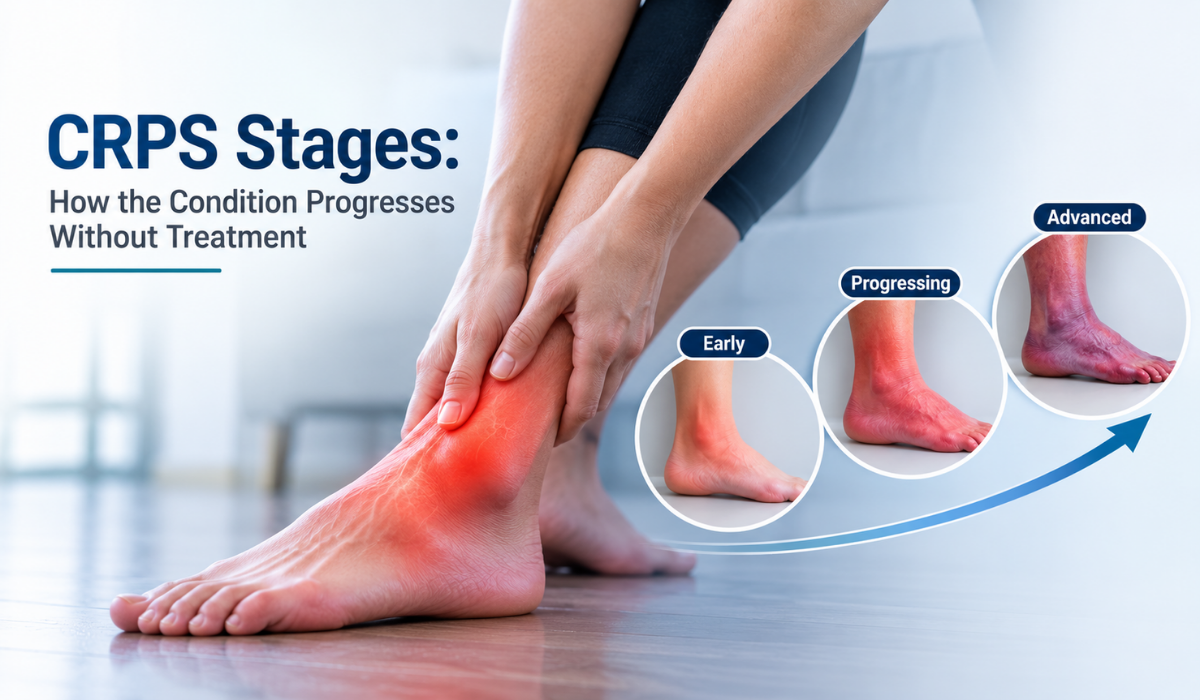
Doctors have long used a three-stage framework to describe how untreated CRPS tends to evolve. It is important to note upfront: this staging model is a simplified teaching tool, not a rigid timeline. Some patients plateau in stage one and never progress; others develop severe features quickly. Modern diagnosis relies on the Budapest clinical criteria rather than which “stage” a patient appears to be in, but the stages remain useful for understanding what untreated CRPS can look like over time.
Stage 1: Acute (Warm) Stage — Roughly the First 1 to 3 Months
- Burning or throbbing pain that is far more intense than the original injury would suggest
- Swelling around the affected joint or limb
- Skin that feels warm, looks red or flushed, and may sweat more than usual
- Increased sensitivity to touch, temperature, or even light pressure from clothing (allodynia)
- Stiffness and reluctance to move the limb due to pain
Expert Insight: This is the stage where treatment has the greatest impact. Because inflammation and sympathetic overactivity are still the dominant drivers, interventions like sympathetic nerve blocks and structured physical therapy tend to work best when started here, within the first few months of symptom onset.
Stage 2: Dystrophic Stage — Roughly 3 to 12 Months
- Pain often becomes more constant and may spread beyond the original site
- Skin may turn cooler, bluish, or mottled as blood flow patterns shift
- Swelling can become firmer and less responsive to elevation
- Hair and nail growth changes — nails may become brittle or grow faster or slower than normal
- Muscle stiffness increases and early joint restriction can begin
Expert Insight: Patients frequently describe this stage as the most frustrating, because the limb starts to feel and look different from the rest of the body, yet standard X-rays or blood tests often still appear normal. This is a common point at which people are told “nothing is wrong” — a real-life scenario that delays proper diagnosis. A pain specialist familiar with CRPS’s clinical (not just imaging) diagnosis is essential here.
Stage 3: Atrophic Stage — Beyond 12 Months
- Skin becomes thin, shiny, and pale, with reduced hair growth
- Muscle wasting (atrophy) develops from prolonged disuse
- Joint stiffness can become fixed, with reduced or lost range of motion (contracture)
- Bone density loss may appear on imaging in the affected limb
- Pain may become less centred on temperature and swelling and more on deep, constant nerve-type pain
Expert Insight: Atrophic-stage changes such as joint contracture and bone loss are much harder to reverse. Treatment at this stage focuses on maximising remaining function, controlling pain, and preventing further decline, rather than a full return to baseline. This is precisely why early intervention in stage one matters so much.
CRPS Stages at a Glance
| Feature | Stage 1: Acute | Stage 2: Dystrophic | Stage 3: Atrophic |
| Typical timing | 0–3 months | 3–12 months | 12+ months |
| Skin | Warm, red, sweaty | Cool, bluish, mottled | Thin, shiny, pale |
| Swelling | Soft, pitting | Firmer, less responsive | Often reduced, replaced by stiffness |
| Pain pattern | Burning, disproportionate | Constant, may spread | Deep, nerve-type, constant |
| Joint mobility | Painful but largely preserved | Early stiffness | Contracture possible |
| Reversibility | Highest with early treatment | Moderate, needs active management | Focus shifts to function preservation |
Symptoms to Watch For
- Pain that is out of proportion to the original injury
- Changes in skin colour or temperature in the affected limb
- Swelling that doesn’t settle with the usual RICE (rest, ice, compression, elevation) approach
- Increased sensitivity to touch, clothing, or temperature
- Stiffness or reduced movement in a joint that shouldn’t otherwise be affected
- Changes in nail or hair growth on the limb
What Drives Progression Without Treatment
CRPS does not worsen simply because time passes — it worsens because the underlying sympathetic nervous system dysfunction, central sensitisation, and inflammatory changes are left unaddressed. Several factors can accelerate progression:
- Delayed diagnosis, often because CRPS has no single confirmatory blood test or scan
- Prolonged immobilisation of the limb out of fear of pain
- Untreated psychological stress, which can amplify pain signalling
- Repeated minor trauma or overly aggressive rehabilitation attempted without guidance
- Underlying nerve injury (CRPS Type II) that continues to generate abnormal signalling
Risk Factors for Faster or More Severe Progression
- Longer delay between injury and first specialist evaluation
- Fracture or surgery involving the wrist, ankle, or hand
- Pre-existing anxiety or chronic stress
- Female sex and age between 40 and 60 years, per population data
- Limited or fear-avoidant movement of the limb after injury
How CRPS Is Diagnosed
There is no single definitive test for CRPS. Diagnosis relies on the Budapest clinical criteria, which combine a patient’s reported symptoms with signs found on physical examination across four categories: sensory, vasomotor, sudomotor/oedema, and motor/trophic changes. Other conditions must be reasonably excluded first. Supporting tools may include thermography, bone scans, or nerve conduction studies, but these support — rather than replace — clinical judgement.
Treatment Options at Each Stage
Non-Surgical and Conservative Approaches
- Graded physical and occupational therapy to maintain movement and desensitise the limb
- Medications such as anti-inflammatories, nerve-pain agents, or short-course steroids in early stages
- Mirror therapy and graded motor imagery for central pain processing
- Psychological support to address stress and pain-related anxiety, which measurably affects outcomes
Interventional Pain Procedures
- Sympathetic nerve blocks to interrupt abnormal sympathetic signalling, most effective in stage one and early stage two
- Spinal cord stimulation for patients with persistent, refractory pain who haven’t responded adequately to conservative care
- Targeted injections for pain relief as part of a broader, individualised plan
- Intrathecal drug delivery systems, considered in select, severe, treatment-resistant cases
Myths vs Facts
| Myth | Fact |
| CRPS is “in the patient’s head.” | CRPS is a recognised physiological condition involving real changes in the nervous system, blood flow, and skin — not a psychological disorder. |
| If X-rays are normal, there’s nothing wrong. | Early-stage CRPS commonly shows normal imaging. Diagnosis is clinical, based on the Budapest criteria, not imaging alone. |
| Once CRPS reaches a later stage, nothing can be done. | Later-stage CRPS is harder to fully reverse, but pain control, functional rehabilitation, and interventional options can still meaningfully improve quality of life. |
| Resting the limb completely is the safest approach. | Prolonged immobility tends to worsen stiffness and progression; guided, graded movement is generally part of an effective plan. |
Common Mistakes Patients Make
- Waiting several months to seek specialist evaluation because symptoms are dismissed as a slow-healing sprain
- Avoiding all movement of the limb out of fear, which can accelerate stiffness and muscle wasting
- Stopping treatment as soon as pain reduces slightly, rather than completing the full rehabilitation plan
- Relying only on painkillers without addressing the underlying sympathetic and central nervous system drivers
Questions Patients Forget to Ask
- Which stage does my presentation most resemble, and what does that mean for my plan?
- What is the realistic timeline for improvement with treatment started now?
- Are there specific home exercises I should — or shouldn’t — be doing between appointments?
- What early warning signs should prompt me to come back sooner rather than waiting for my next visit?
Practical Action Plan
- Seek evaluation promptly if pain, swelling, or skin changes persist well beyond what the original injury would explain.
- Ask specifically about CRPS and the Budapest criteria if a treating doctor hasn’t raised it.
- Start a structured, guided physical therapy programme rather than either total rest or unsupervised exercise.
- Discuss interventional options such as a sympathetic nerve block early if conservative care isn’t controlling pain.
- Track symptoms (pain level, skin colour, swelling, mobility) to help your specialist judge whether the condition is stable, improving, or progressing.
Nexus Pain Expert Summary
CRPS is most manageable when it is caught and addressed early, before sympathetic overactivity gives way to fixed joint and tissue changes. At Nexus Advanced Pain Management, evaluation for suspected CRPS includes a detailed clinical assessment against recognised diagnostic criteria, followed by an individualised plan that may combine physical rehabilitation with interventional options such as sympathetic nerve blocks or, for refractory cases, spinal cord stimulation. The goal at every stage is the same: control pain, preserve function, and prevent avoidable progression.
How Nexus Pain Can Help
Nexus Advanced Pain Management supports patients with suspected or confirmed CRPS through comprehensive clinical assessment, evidence-based treatment planning, and access to interventional options such as sympathetic nerve blocks, targeted injections for pain relief, and spinal cord stimulation for cases that don’t respond adequately to conservative care. Care is coordinated around each patient’s stage of symptoms,functional goals, and rehabilitation needs, with the aim of preventing avoidable long-term decline and supporting a realistic path toward better pain control.
Key Takeaways
- CRPS is commonly described in three stages — acute, dystrophic, and atrophic — but progression varies by individual.
- Disproportionate pain, swelling, and skin or temperature changes after an injury are the earliest red flags.
- There is no single test for CRPS; diagnosis relies on clinical criteria and ruling out other causes.
- Earlier treatment, particularly in the acute stage, gives the best chance of controlling symptoms.
- Later-stage changes such as joint contracture and muscle wasting are harder to reverse but can still be managed.
- A combination of physical therapy, medication, and interventional procedures like sympathetic nerve blocks forms the backbone of treatment.
- Prolonged immobility tends to worsen outcomes; guided movement is usually part of the plan.
Frequently Asked Questions
What are the three stages of CRPS?
The traditional model describes an acute (warm) stage, a dystrophic stage, and an atrophic stage, each marked by different skin, swelling, and pain patterns as described earlier in this article.
How quickly does CRPS progress?
Progression varies widely. Some patients remain in the acute stage for a long time or improve with treatment, while others develop later-stage changes within a year if untreated.
Can CRPS go away on its own?
Some mild cases improve without formal treatment, but relying on spontaneous resolution is risky since the condition can also worsen. Evaluation is recommended if symptoms persist beyond a few weeks.
Is CRPS the same as reflex sympathetic dystrophy?
Yes. Reflex sympathetic dystrophy is the older name for CRPS Type I, the form without a confirmed nerve injury.
What is the difference between CRPS Type I and Type II?
CRPS Type II occurs after a clearly identified nerve injury, while CRPS Type I occurs without one. Clinically, the two present very similarly.
Can late-stage CRPS symptoms be reversed?
Full reversal becomes harder once joint contracture, bone loss, or significant muscle wasting develop, but pain control and functional improvement are still achievable goals.
What tests confirm CRPS?
There is no single confirmatory test. Diagnosis uses the Budapest clinical criteria, supported by tools like thermography or bone scans when needed.
Does CRPS always spread beyond the original injury site?
Not always, but pain and sensitivity can spread to a wider area of the limb, and in some cases to other limbs, particularly if untreated.
What is a sympathetic nerve block and how does it help CRPS?
It is an injection that temporarily interrupts abnormal sympathetic nervous system signalling to the affected limb, which can reduce pain and improve mobility, especially when done early.
Is physical therapy safe for CRPS?
Yes, when it is graded and guided by a professional familiar with CRPS. Complete immobility tends to worsen stiffness, while unsupervised aggressive exercise can flare pain.
When should I see a pain specialist for suspected CRPS?
As soon as pain, swelling, or skin changes seem disproportionate to an injury and aren’t settling within the expected healing window — earlier evaluation generally means more treatment options.
Can children develop CRPS?
It is uncommon but possible, most often in adolescents, and it typically presents in a leg or foot.