
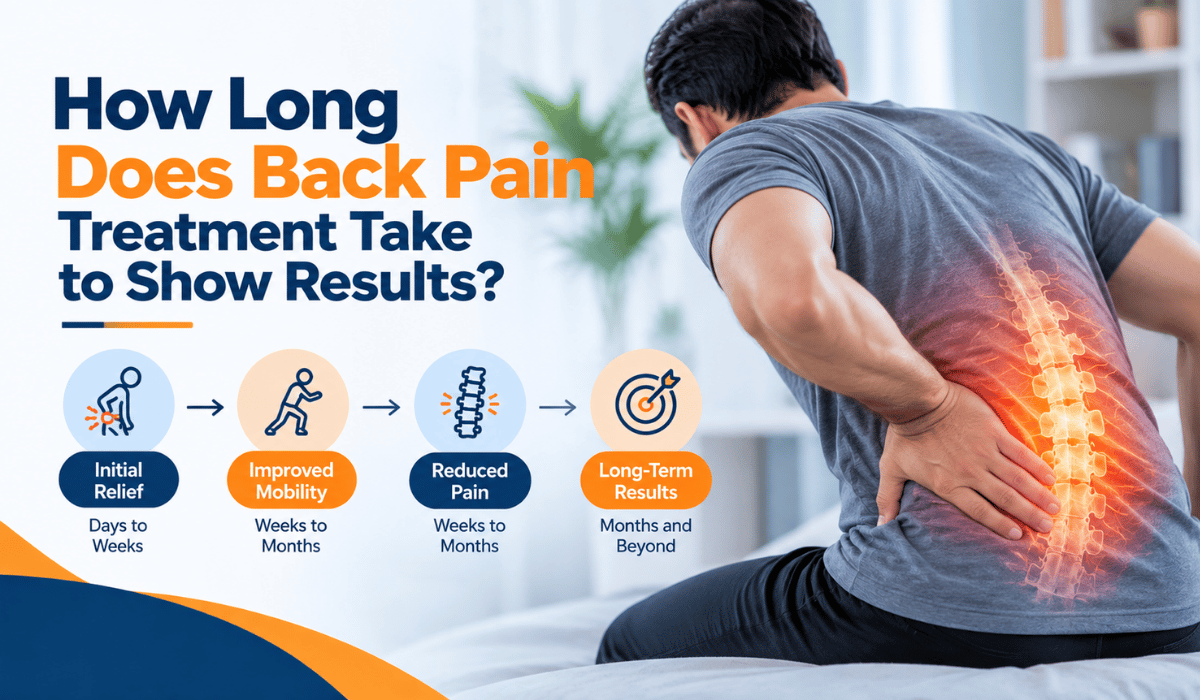

Quick Answer
There is no single timeline, because it depends on the cause of your back pain and the treatment used. Many new episodes of non-specific back pain improve noticeably within about six weeks, with or without a procedure. Exercise-based care needs several weeks of consistency, steroid injections may work within days, and radiofrequency ablation can take one to six weeks to settle. If there is no real progress by six weeks, or any warning sign appears, a specialist assessment is the sensible next step.
Quick Summary
- Back pain is acute (under 6 weeks), subacute (6–12 weeks) or persistent (12 weeks or more), and the stage shapes recovery.
- Large reviews show the steepest improvement in the first six weeks, then slower change.
- Treatments run on different clocks: exercise over weeks, steroid injections over days, RFA over one to six weeks.
- Judge progress by function (sleeping, sitting, walking, working), not only a pain score.
- Pain lasting beyond three months needs a specific diagnosis and plan.
- Leg weakness, groin numbness or bladder and bowel changes need same-day emergency care.
Introduction
Once treatment starts, the question is always: how long until I feel better? The honest answer is “it depends”, so this guide explains on what. It covers typical timelines for each treatment, how to tell whether your plan is working, and when to ask for reassessment. It is general education, not a diagnosis. Your own timeline should be set after an examination.
Why the Timeline Differs From Person to Person
A 2024 systematic review in CMAJ pooled 95 studies and about 18,000 people. Those with acute and subacute low back pain improved substantially in the first six weeks, then progress slowed. Those whose pain was already persistent showed only minimal improvement over time, and many with recent pain still had some a year later.
Two things follow. Much early improvement happens naturally, so not every early gain can be credited to a treatment. And back pain can persist after the original strain has healed, because the pain system itself becomes more sensitive, which is why long-standing pain needs a different strategy.
What Usually Decides Your Timeline
- The source of pain: muscle or ligament strain, disc, facet joint or irritated nerve root all behave differently.
- Duration: recovery is slower once pain passes three months.
- Diagnostic accuracy: a treatment aimed at the wrong source will not work on any schedule.
- Consistency: exercise programmes work only if they are done regularly.
- Sleep, stress, mood, fear of movement and the physical demands of your job.
Typical Timelines by Treatment
These are general ranges from clinical sources, not promises. Some people do not respond to a given treatment.
| Approach | When change may begin | Fuller effect and duration | Best suited to |
| Staying active, self-care, medicines as advised | Days to a few weeks | Most acute episodes improve substantially by about 6 weeks | New episodes without red flags |
| Structured exercise or physiotherapy | Often a few weeks of regular practice | Gains build over weeks to months; continuing helps prevent recurrence | Most back pain, including persistent |
| Epidural or transforaminal steroid injection | Usually 2–7 days; pain may flare for 2–3 days first | Relief lasts days to months; some get none; the cause is not treated | Leg or arm pain from an irritated nerve root |
| Radiofrequency ablation (RFA) | Soreness first; relief often builds over 1–3 weeks, sometimes up to 6 | When effective, often 6–12 months or longer; nerves can regrow | Facet-joint pain confirmed by diagnostic blocks |
| PRP and other regenerative injections | Gradual; judged over weeks to months | Evidence for back pain is limited and mixed | Selected cases after specialist evaluation |
Guidelines are more selective than many clinic pages suggest. NICE favours exercise-led care first, reserves RFA for chronic, localised pain after a positive diagnostic block, and supports epidurals mainly for acute, severe sciatica.
How to Tell Whether Treatment Is Working
A pain score alone is a poor yardstick. Look for sitting longer, sleeping better, walking further, fewer flare-ups and less reliance on medicines. An occasional flare-up does not mean the plan has failed.
Three Reassessment Checkpoints
- Weeks 1–2: early changes in movement or sleep are encouraging, even if pain remains.
- Weeks 4–6: expect a clear direction of improvement. If not, ask whether the diagnosis or plan needs revisiting.
- By week 12: pain is now persistent. This calls for a defined diagnosis and longer-term plan, as recovery chances fall once pain lasts months.
A Hypothetical Example
Illustrative only: a desk worker develops back pain after a long journey. It eases by week three, and with graded exercise and a workstation change they sit through meetings with mild discomfort by week six. Someone whose nerve-root leg pain has not eased by six weeks may instead be assessed for an injection. Same symptom, different pathways.
Myths vs Facts
| Myth | Fact |
| Bed rest is the fastest way to heal. | Guidelines encourage staying active within comfort. |
| If an injection has not worked in a week, it has failed. | Steroid injections can take up to a week; RFA can take weeks to settle. |
| Chronic back pain never improves. | Improvement is slower on average, but structured plans can still improve function. |
When Back Pain Needs Urgent Care
Go to an emergency department the same day if back pain comes with any of the following:
- Loss of bladder or bowel control, or difficulty passing urine
- Numbness around the groin, genitals, buttocks or inner thighs
- Weakness or numbness in both legs, or leg weakness that is rapidly worsening
- Fever, unexplained weight loss, or a cancer history with new back pain
- Back pain after significant trauma
Questions Patients Forget to Ask a Pain Specialist
- What is the likely source of my pain, and how certain is that?
- What improvement should I expect at 2, 6 and 12 weeks?
- What if there is no improvement by the checkpoint?
- What are the risks, and how likely is this to help someone like me?
Practical Action Plan
- Note when pain began, what worsens or eases it, and its effect on sleep, work and walking.
- Stay active within comfort and build up a graded exercise routine.
- Book an assessment if there is no clear improvement by about six weeks, pain keeps returning, or leg symptoms appear.
- If a procedure is suggested, ask which finding supports it and what timeline to expect.
- Review at agreed checkpoints, tracking function as well as pain.
Nexus Advanced Pain Management Expert Summary
Timelines in back pain are ranges, not deadlines. Most new episodes improve in the first six weeks. After that, a clear diagnosis matters more than another round of the same treatment. Procedures are tools for specific, identified pain sources, and they work best alongside movement, strengthening and realistic expectations.
How Nexus Advanced Pain Management Can Help
When back pain outlasts the usual recovery window or keeps returning, a structured assessment can clarify the source and next step. Nexus Advanced Pain Management in Ahmedabad offers:
- Comprehensive pain assessment to identify the likely source before treatment is chosen.
- Non-surgical options matched to the cause, such as transforaminal blocks and injections for pain relief for suspected nerve-root irritation, and radiofrequency ablation for suspected facet-joint pain after appropriate evaluation.
- Regenerative options such as PRP therapy, discussed alongside the current evidence.
- Long-term chronic pain management planning, with guidance on activity and lifestyle.
If you are looking for a pain specialist in Ahmedabad because back pain has not improved after several weeks, an assessment can help you decide what to do next. Outcomes vary from person to person.
Key Takeaways
- Many new episodes improve within about six weeks, but some people have ongoing pain beyond that.
- Each treatment has its own clock: days for steroid injections, weeks for RFA and exercise.
- Track function, not just pain, and reassess at about 2, 6 and 12 weeks.
- Leg weakness, groin numbness and bladder or bowel changes are emergencies.
Frequently Asked Questions
How long does an epidural steroid injection take to work for back pain?
Most people notice a change within about 2–7 days, after a possible 2–3 day flare. Relief may last days to months, and some people do not respond.
How long does radiofrequency ablation take to show results?
Relief often builds over one to three weeks and can take up to six. When it works, it commonly lasts 6–12 months or longer, as nerves can regrow.
How long does physiotherapy take to help back pain?
Many people notice gradual change within a few weeks of regular practice, with fuller gains over weeks to months. Continuing exercises helps reduce recurrence.
How long does slip disc back pain take to improve?
Many people with disc-related nerve irritation improve over weeks to a few months, but timelines vary, and some need longer or further assessment.
Should I see a doctor if my back pain has not improved in six weeks?
Yes. No clear improvement by about six weeks is a good point for reassessment. Seek help sooner for leg weakness, numbness or bladder and bowel changes.
When should I see a pain specialist in Ahmedabad rather than keep waiting?
Consider an assessment if pain has lasted beyond six weeks, keeps returning, spreads into the leg, or limits sleep and work. Urgent symptoms need emergency care.