
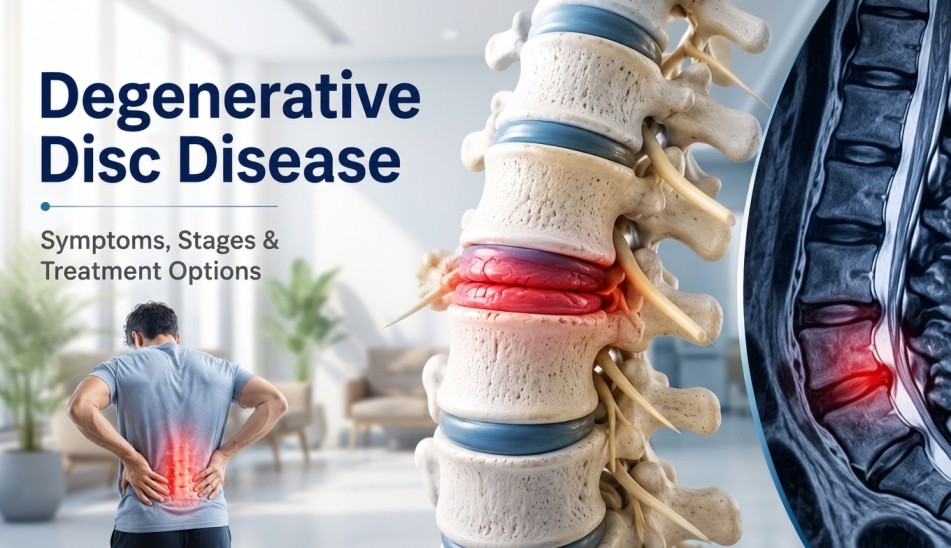

QUICK ANSWER: What Is Degenerative Disc Disease? |
| Degenerative Disc Disease (DDD) happens when the discs between the bones of your spine gradually lose their strength, flexibility, and cushioning over time. As these discs wear down, they can cause back pain, stiffness, and reduced mobility. |
| Despite the name, DDD is not actually a disease. It is a common age-related change that may develop faster due to factors such as injury, lifestyle habits, or genetics. |
| The good news is that most people can manage DDD successfully without surgery through personalized treatment options such as physical therapy, interventional pain procedures, and regenerative medicine. |
QUICK SUMMARY — KEY FACTS |
| • Degenerative Disc Disease affects the cushioning discs between spinal vertebrae |
| • Common in adults over 40 but can occur earlier due to injury or lifestyle factors |
| • Symptoms include chronic back/neck pain, stiffness, numbness, and leg pain (sciatica) |
| • DDD progresses through 4 identifiable stages — early identification improves outcomes |
| • Most patients respond well to non-surgical treatment: physiotherapy, injections, RFA, PRP |
| • Surgery is rarely necessary and is considered only when conservative treatments fail |
| • Lifestyle changes — posture correction, weight management, and exercise — play a critical role |
| • Nexus Pain Clinic in Ahmedabad offers comprehensive, personalized DDD management plans |
When Your Spine’s Shock Absorbers Wear Out
Imagine carrying a 10-kg bag on your back, every single day, for 40 years. That is essentially what your spinal discs do. These remarkable structures absorb shock, allow movement, and protect your spinal cord — all without rest. Degenerative Disc Disease (DDD) is what happens when that constant wear and tear begins to take its toll.
In India, millions of adults silently endure chronic back pain that is often rooted in disc degeneration. Office workers spending 8-10 hours seated, homemakers with repetitive bending movements, and athletes with high-impact sports histories are all at elevated risk. Understanding DDD early makes a significant difference in outcomes — and the good news is that the vast majority of patients do not require surgery.
This guide covers everything you need to know about DDD — its symptoms, stages, causes, diagnosis, and the full range of treatment options available at a pain management clinic in Ahmedabad.
What Is Degenerative Disc Disease?
Each spinal disc is composed of two parts: a tough outer ring called the annulus fibrosus, and a soft gel-like centre called the nucleus pulposus. Together, they function as the spine’s shock absorbers. With age — or due to injury and lifestyle factors — these discs begin to lose hydration, height, and structural integrity.
The result is a narrowed disc space, increased pressure on surrounding nerves and joints, and the development of pain signals that the brain interprets as back pain, neck pain, or radiating leg and arm pain. Over time, bone spurs (osteophytes) may form as the body attempts to compensate, sometimes narrowing the spinal canal in a condition called spinal stenosis.
| EXPERT INSIGHT #1 |
| “DDD is often misunderstood as an automatic path to surgery. In reality, the severity of imaging findings does not always correlate with the level of pain a patient experiences. |
| Many patients with advanced disc degeneration on MRI live pain-free, while others with mild degeneration experience significant discomfort. |
| This is why personalised treatment — not imaging-based assumptions — drives better outcomes.” |
Stages of Degenerative Disc Disease
DDD typically progresses through four stages. Identifying the stage early allows for timely, targeted intervention:
| Stage | What Happens | Common Symptoms |
| Stage 1 — Early Degeneration | Disc begins losing water content; minor structural changes | Mild stiffness, occasional back ache |
| Stage 2 — Disc Height Loss | Disc starts to flatten; annulus shows micro-tears | Recurring back pain, reduced flexibility |
| Stage 3 — Disc Collapse | Significant height loss; nerve compression begins | Chronic pain, numbness, radiating leg/arm pain |
| Stage 4 — Advanced Degeneration | Bone-on-bone contact; osteophytes form; possible stenosis | Severe pain, weakness, possible sciatica |
Early-stage DDD responds exceptionally well to conservative and minimally invasive treatments. Waiting until Stage 4 significantly narrows your options.
Symptoms of Degenerative Disc Disease
Symptoms vary depending on which part of the spine is affected — the lower back (lumbar) or the neck (cervical) — and the extent of nerve involvement:
Lumbar DDD (Lower Back)
- Persistent lower back pain that worsens with prolonged sitting or bending
- Pain that radiates down one or both legs (sciatica)
- Numbness or tingling in the feet and toes
- Muscle weakness in the legs
- Stiffness after waking up or long periods of inactivity
Cervical DDD (Neck)
- Neck pain and stiffness, especially after screen time
- Pain radiating into the shoulder, arm, or fingers
- Headaches originating from the base of the skull
- Reduced range of neck motion
- Grip weakness or fine motor difficulty
| REAL-LIFE SCENARIO |
| Priya, 42, an IT project manager in Ahmedabad, dismissed her persistent lower back pain as “office fatigue.” |
| After 8 months of worsening numbness in her right leg, an MRI revealed Stage 3 lumbar DDD with mild nerve compression. |
| With a structured 12-week non-surgical program — physical therapy, posture correction, and a targeted epidural injection — she returned to full work capacity without surgery. |
Causes and Risk Factors
While aging is the primary cause of disc degeneration, several factors accelerate the process:
| Cause / Risk Factor | How It Contributes |
| Natural Aging (35-50+) | Discs lose up to 80% of their water content with age |
| Prolonged Sitting / Desk Work | Increases intradiscal pressure; weakens supporting muscles |
| Smoking | Reduces blood supply to discs, accelerating degeneration |
| Obesity / Excess Weight | Adds mechanical load on lumbar discs |
| Past Spinal Injuries | Micro-tears in the annulus trigger accelerated breakdown |
| Genetics | Family history of spine issues increases risk by up to 60% |
| Heavy Manual Labour | Repetitive lifting and bending damages disc structure |
| Poor Posture (Forward Head / Slouching) | Creates uneven load distribution across discs |
How Is Degenerative Disc Disease Diagnosed?
A thorough diagnosis of DDD involves a combination of clinical assessment and imaging studies. A pain specialist in Ahmedabad will typically follow this pathway:
- Detailed medical history and pain pattern assessment
- Physical examination — neurological testing, range of motion, posture analysis
- MRI Spine (Gold Standard) — reveals disc height, hydration, nerve compression
- X-Ray Spine — shows disc space narrowing and bone spur formation
- CT Scan — evaluates bone anatomy and canal dimensions
- Nerve Conduction Studies (if neurological symptoms are present)
| COMMON MISTAKE #1 |
| Many patients rely on X-rays alone for diagnosis. While X-rays can show bone changes, they cannot visualize disc degeneration, hydration changes, nerve compression, or soft tissue involvement. |
| MRI is essential for accurate diagnosis, staging, and treatment planning in Degenerative Disc Disease (DDD). |
Treatment Options for Degenerative Disc Disease
The treatment approach is determined by the stage of degeneration, symptom severity, and the patient’s overall health. The vast majority of patients — over 90% — are successfully managed without surgery.
Non-Surgical Treatment Options
| Treatment | How It Helps |
| Physiotherapy & Exercise | Strengthens spinal muscles, improves posture, reduces disc load |
| Pain Medications (Short-Term) | NSAIDs and muscle relaxants for acute pain episodes |
| Epidural Steroid Injections | Reduces inflammation around compressed nerves (lumbar/cervical) |
| Facet Joint Injections | Targets facet joint pain — a common DDD complication |
| Radiofrequency Ablation (RFA) | Interrupts pain signals from facet joints; effects last 6-18 months |
| PRP (Platelet-Rich Plasma) Therapy | Regenerative treatment using growth factors to support disc repair |
| Spinal Decompression Therapy | Traction-based treatment to reduce disc pressure |
| Lifestyle & Posture Modification | Core strengthening, ergonomic correction, weight management |
| EXPERT INSIGHT #2 |
| ” Radiofrequency Ablation (RFA) can be an effective treatment option for DDD-related facet joint pain.” |
| “By interrupting pain signals from the affected facet joints, RFA may provide meaningful pain relief and improve function.” |
| “This often helps patients participate more comfortably in physiotherapy, rehabilitation, and daily activities.” |
When Is Surgery Considered?
Surgery for DDD is considered only when all conservative measures have failed over an adequate period (typically 6+ months), and the patient has clear structural pathology causing neurological deficit. Common surgical options include spinal fusion and disc replacement — but these carry their own risks and are not appropriate for most DDD patients.
| COMMON MISTAKE #2 |
| Patients often assume that an MRI showing disc degeneration means surgery is inevitable. |
| This is incorrect. Imaging findings must always be correlated with clinical symptoms. |
| Many patients with severe-looking MRI results are effectively managed non-surgically. |
The Role of Stem Cell Therapy in Degenerative Disc Disease
Stem Cell Therapy is an advanced regenerative treatment that may help support the body’s natural healing response in selected patients with Degenerative Disc Disease (DDD). While it cannot completely reverse disc degeneration, it may help reduce inflammation, improve function, and support tissue repair. For patients with early-to-moderate disc damage, Stem Cell Therapy may be considered as part of a comprehensive non-surgical treatment plan alongside physiotherapy, lifestyle modifications, and other interventional pain management techniques.
Myths vs Facts: Degenerative Disc Disease
| Myth | Fact | Why It Matters |
| DDD always leads to surgery | 90%+ of DDD patients are managed non-surgically | Patients avoid unnecessary procedures |
| Only elderly people get DDD | DDD can begin in the 30s due to injury or lifestyle | Young adults must not ignore early symptoms |
| Rest is the best treatment for DDD | Prolonged rest weakens spinal muscles and worsens outcomes | Guided activity is safer than complete rest |
| DDD means permanent disability | Most patients return to full activity with proper treatment | Realistic expectations improve adherence |
| A herniated disc and DDD are the same | DDD is disc degeneration; herniated disc is a complication that may result from DDD | Accurate diagnosis ensures correct treatment |
Prevention Tips: Protecting Your Spinal Discs
- Maintain a healthy body weight — every extra kilogram adds disproportionate load on lumbar discs
- Exercise regularly — swimming, walking, and core strengthening are disc-friendly
- Correct your sitting posture — use ergonomic chairs, maintain lumbar support
- Take movement breaks every 45-60 minutes if you have a desk job
- Quit smoking — nicotine directly impairs disc nutrition
- Lift correctly — bend at the knees, not the waist
- Stay hydrated — discs are 80% water and depend on adequate hydration
- Address back pain early — do not wait for it to become chronic
| EXPERT INSIGHT #3 |
| “One of the most overlooked ways to slow the progression of Degenerative Disc Disease (DDD) is by strengthening the deep core muscles, particularly the multifidus and transversus abdominis.” |
| “These muscles help support and stabilize the spine, acting like a natural brace during daily activities.” |
| “Patients with stronger core stability often experience better function, improved posture, and greater long-term spinal health.” |
Recovery and Rehabilitation Timeline
Recovery from DDD is an ongoing, active process rather than a single treatment event. Here is a general rehabilitation timeline:
| Phase | Focus & Activities |
| Weeks 1-4 (Acute Phase) | Pain control, anti-inflammatory measures, gentle range-of-motion exercises |
| Weeks 4-12 (Rehabilitation Phase) | Physiotherapy, core strengthening, posture re-education, interventional procedures if needed |
| Months 3-6 (Functional Restoration) | Return to work/sport activities, ergonomic correction, lifestyle modifications |
| Ongoing (Long-Term Management) | Home exercise program, periodic reassessment, lifestyle maintenance |
| COMMON MISTAKE #3 |
| Many patients stop their rehabilitation exercises as soon as their pain improves — often within 4-6 weeks. |
| This premature discontinuation is the leading cause of DDD symptom recurrence. |
| Long-term pain management requires sustained lifestyle and exercise habits. |
Questions Patients Often Forget to Ask Their Doctor
- Which stage of DDD do I have, and what does that mean for my treatment?
- Will my condition worsen over time even with treatment?
- Is my work environment contributing to my disc degeneration?
- How long before I can expect meaningful pain relief from the recommended treatment?
- Are there specific exercises I must avoid given my DDD stage?
- What are the signs that I may need to escalate to a more advanced procedure?
- Is PRP therapy or regenerative medicine suitable for my case?
- How frequently should I come back for reassessment?
Your Practical Action Plan: What to Do Next
| STEP-BY-STEP ACTION PLAN |
| Step 1: Do not ignore persistent back or neck pain lasting more than 4 weeks |
| Step 2: Consult a pain specialist — not just a general physician — for accurate spine evaluation |
| Step 3: Get an MRI Spine for proper staging (X-ray alone is insufficient) |
| Step 4: Receive a personalised treatment plan — not a generic one |
| Step 5: Begin physiotherapy and core strengthening alongside any procedure |
| Step 6: Make ergonomic and lifestyle changes as a long-term commitment |
| Step 7: Attend follow-up appointments — DDD management is ongoing, not one-time |
| Step 8: Set realistic expectations — significant improvement is achievable without surgery |
How Nexus Pain Management Clinic Can Help
At Nexus Pain Management Clinic in Ahmedabad, patients with degenerative disc disease receive a comprehensive, evidence-based evaluation that goes beyond standard imaging review. The clinical approach at Nexus Pain integrates:
- Detailed assessment of pain patterns, functional limitations, and imaging findings
- Personalised, non-surgical treatment plans aligned with the patient’s stage, lifestyle, and goals
- Interventional pain procedures including epidural steroid injections, facet joint injections, and radiofrequency ablation
- Regenerative medicine options such as PRP therapy for eligible candidates
- Structured physiotherapy and rehabilitation protocols
- Lifestyle modification and ergonomic counselling for long-term management
- Regular follow-up and reassessment to track progress and adjust treatment as needed
Whether you are at Stage 1 of disc degeneration or have been managing DDD symptoms for years, a structured pain management plan can meaningfully improve your quality of life. Patients from across Ahmedabad and Gujarat have benefited from non-surgical approaches that restore function and reduce dependence on pain medications.
| NEXUS PAIN EXPERT SUMMARY |
| Degenerative Disc Disease (DDD) is a common and manageable condition. Early diagnosis, accurate assessment, and a personalized treatment plan are key to reducing pain and improving quality of life. In many cases, surgery can be avoided with the right non-surgical approach. |
| A combination of interventional pain treatments, physiotherapy, exercise, and lifestyle modifications can help many patients achieve meaningful pain relief and improved function. |
| If you are experiencing persistent back or neck pain, seeking expert evaluation early may help prevent symptoms from worsening and support better long-term outcomes. |
Key Takeaways
- DDD is a natural aging process, not an automatic path to surgery or disability
- It progresses through 4 stages — early identification leads to better, simpler treatment
- Symptoms include back/neck pain, numbness, radiating leg pain, and stiffness
- MRI is the gold standard for diagnosis — X-ray alone is insufficient
- 90%+ of patients are managed effectively with non-surgical treatment
- Radiofrequency Ablation, epidural injections, and PRP therapy offer targeted relief
- Physiotherapy and core strengthening are essential alongside any procedure
- Lifestyle changes — posture, weight, movement breaks — protect remaining disc health
- Never stop rehabilitation early — consistency determines long-term outcomes
- Nexus Pain Clinic in Ahmedabad provides personalised, evidence-based DDD management
Frequently Asked Questions
Q1. What is degenerative disc disease, and is it serious?
Degenerative Disc Disease (DDD) refers to the gradual breakdown of spinal discs. While it sounds alarming, it is an extremely common condition and is rarely life-threatening. Most patients manage it effectively with non-surgical treatment. It becomes serious only when significant nerve compression or spinal instability is left untreated.
Q2. At what age does degenerative disc disease typically start?
Disc degeneration begins as early as the late 20s to 30s at a microscopic level. Symptoms typically become noticeable between the ages of 40 and 60. However, athletes, those with prior spinal injuries, or people with genetic predisposition may experience symptoms earlier.
Q3. Can degenerative disc disease be cured permanently?
DDD cannot be reversed entirely, as it involves structural changes to the disc. However, symptoms can be significantly reduced or eliminated with the right treatment plan. Many patients achieve long-term pain relief and full functional recovery through non-surgical management and lifestyle modification.
Q4. What is the difference between a slip disc and degenerative disc disease?
A slip disc (herniated disc) occurs when the inner gel of the disc pushes through a tear in the outer ring, pressing on nearby nerves. DDD refers to the overall degeneration of the disc over time. DDD can make a disc more vulnerable to herniation, but they are distinct conditions requiring slightly different treatment approaches.
Q5. Is walking good or bad for degenerative disc disease?
Walking is generally beneficial for DDD. It promotes circulation, strengthens surrounding muscles, and maintains mobility without placing excessive load on the spine. Low-impact activities such as walking, swimming, and cycling are typically recommended. High-impact activities like running on hard surfaces should be avoided during flare-ups.
Q6. How long does degenerative disc disease treatment take?
The timeline varies by stage and individual response. Most patients notice meaningful improvement within 4 to 12 weeks of a structured treatment program. Advanced cases involving interventional procedures may require 3 to 6 months of comprehensive management. Long-term maintenance is ongoing.
Q7. What is radiofrequency ablation (RFA) and how does it help DDD?
Radiofrequency Ablation (RFA) is a minimally invasive procedure in which heat energy is used to interrupt pain signals from specific nerves — particularly the facet joint nerves affected by disc degeneration. It provides targeted, long-lasting relief of 6 to 18 months and is performed as a day procedure under image guidance.
Q8. Is PRP therapy effective for degenerative disc disease?
PRP (Platelet-Rich Plasma) therapy uses the patient’s own growth factors to support tissue healing and reduce inflammation. Evidence for PRP in disc degeneration is growing, particularly for early-to-moderate stage DDD. It is considered when conventional treatments provide insufficient relief and where regenerative support may slow progression.
Q9. What should I avoid if I have degenerative disc disease?
Patients with DDD should generally avoid prolonged sitting without movement breaks, heavy lifting with a bent spine, high-impact activities during symptomatic periods, smoking (which accelerates disc degeneration), and sleeping on overly soft mattresses that do not support spinal alignment.
Q10. When should I see a pain specialist for back pain in Ahmedabad?
You should consult a pain specialist if your back or neck pain persists beyond 4 weeks, if it is worsening or radiating to your limbs, if you experience numbness, tingling, or muscle weakness, or if over-the-counter medication is not providing adequate relief. Early specialist assessment prevents progression to more advanced DDD stages.
Q11. Can DDD cause paralysis?
DDD causing paralysis is extremely rare and typically involves significant untreated spinal stenosis or severe nerve compression over many years without any intervention. This is why early diagnosis and treatment are important. The vast majority of DDD patients never approach this level of severity.
Q12. Is surgery the only option for severe DDD?
No. Even advanced DDD cases are often managed with a combination of interventional procedures such as epidural steroid injections, RFA, and targeted physiotherapy. Surgery is considered only when neurological function is severely compromised and conservative treatments have failed over an adequate period.
Q13. What is the approximate cost of DDD treatment in Ahmedabad?
Treatment costs vary depending on the severity of the condition and the treatment approach selected. Basic physiotherapy programs are relatively affordable, while interventional procedures such as epidural injections or RFA involve additional clinical costs. A pain specialist at Nexus Pain Clinic in Ahmedabad will discuss all options and associated considerations during your initial assessment.
Q14. Can degenerative disc disease affect younger people?
Yes. While DDD is primarily associated with aging, young adults in their 20s and 30s can develop it — particularly athletes, those with prior spinal injuries, individuals with sedentary desk jobs, and those with a family history of spine conditions. Young-onset DDD is often more responsive to early intervention.
Q15. How is Nexus Pain Clinic different from a general physician for DDD treatment?
A pain management specialist at Nexus Pain Clinic offers a level of specialisation beyond general care. This includes advanced diagnostic capability, access to interventional procedures not available in general settings, expertise in non-surgical spine management, and personalised rehabilitation planning — all within a dedicated pain management framework.