

Quick Answer
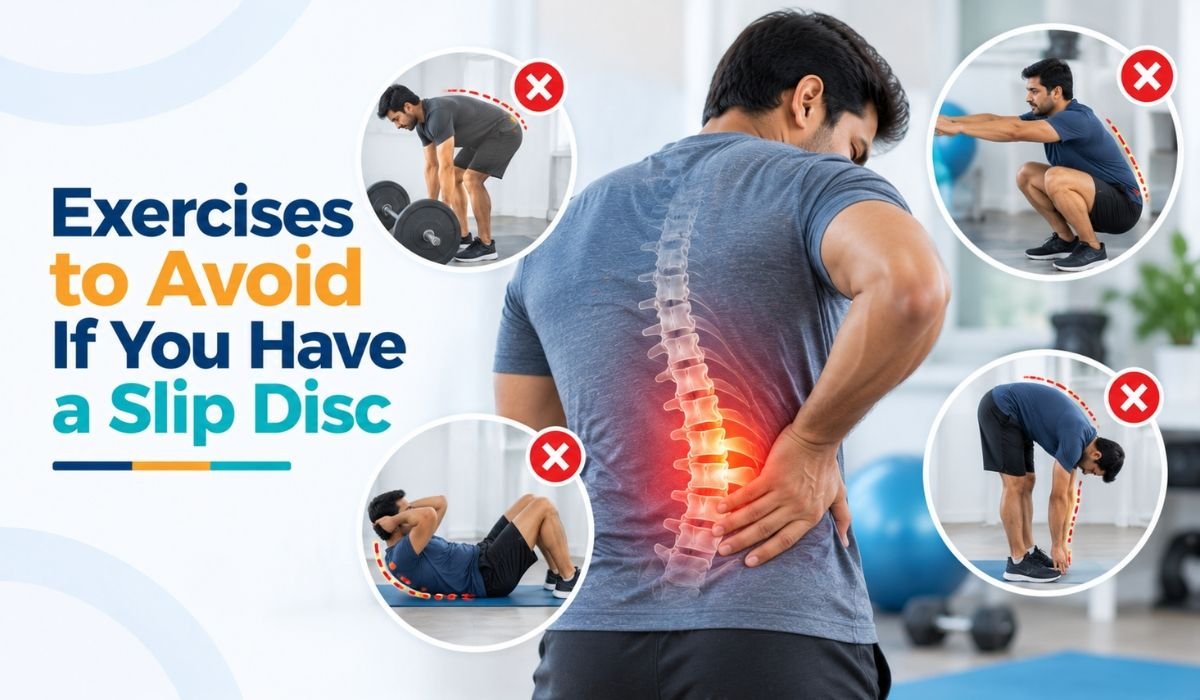
If you have a slip disc, avoid movements that repeatedly round your lower back under load (sit-ups, toe touches, heavy deadlifts), high-impact activity (running, jumping), forceful twisting, and any exercise that pushes pain, numbness or tingling further down your leg. Long bed rest is not the answer either; most people recover better by staying gently active. Exactly what bothers you depends on where the disc is and which way it bulges, so an assessment matters more than any generic list.
Quick Summary
- A “slip disc” (herniated or prolapsed disc) does not literally slip; the disc’s soft centre bulges and may irritate a nerve.
- Most people improve over weeks to months without surgery, and gentle movement usually beats prolonged rest.
- During a flare-up, the usual culprits are loaded forward bending, heavy lifting, impact and forceful twisting.
- Your symptoms are the best filter: pain that travels further down the leg is a stop signal.
- Saddle numbness, bladder or bowel changes, or worsening weakness need emergency care.
A slip disc diagnosis tends to raise two opposite worries: will moving make it worse, and will resting make me weaker? Both are reasonable. For most people the answer is to keep moving, but not every movement, and not at every stage. This guide explains which exercises commonly aggravate a slip disc, why, what to do instead, and when to stop and get help. It is general education, not an assessment of your own spine.
What a “Slip Disc” Is, and Why Exercise Choice Matters
Spinal discs are cushions with a tough outer ring (annulus fibrosus) and a soft, jelly-like centre (nucleus pulposus). In a slip disc, that centre pushes against or through the ring and can irritate a nearby nerve root. The American Academy of Orthopaedic Surgeons (AAOS) notes that most people feel much better within a few weeks or months of non-surgical care, and that the herniated material is often gradually reabsorbed. Exercise choice matters because some movements load or pull on the irritated area, while others keep you conditioned without doing either.
The Golden Rule: Let Your Symptoms Set the Limit
Discs herniate in different directions, so no single list suits everyone. NHS guidance says the type of exercise matters less than whether it worsens your pain. Use your response as the filter:
- Stop if leg or arm pain, numbness or tingling spreads further from the spine or becomes sharper.
- Notice how you feel later that day and the next morning, not only during the movement.
- Mild, brief, local discomfort may be acceptable, but agree that threshold with your clinician.
Physiotherapists using the McKenzie method call pain that moves back toward the spine “centralisation” and treat it as a good sign. A 2025 meta-analysis found only low-certainty evidence of short-term benefit, so treat this as a guide, not a guarantee.
Exercises and Movements to Avoid With a Slip Disc
These patterns are most often flagged during a flare-up. Most of this guidance rests on biomechanics research and clinical consensus rather than trials of avoid-lists. “Avoid” usually means pause or modify until you are assessed, not never again.
| Movement | Examples | Why it is flagged | Often discussed instead |
| Loaded forward bending | Sit-ups, crunches, toe touches, leg press, deep forward folds | Repeated flexion under load injured discs in lab studies; sit-ups are modelled at about 3,300 N of compression. | Walking; neutral-spine core work such as bird-dog |
| Heavy lifting | Deadlifts, heavy squats, overhead press, lifting loads from the floor | Adds compression, especially when technique or core control fades. | Lighter loads; hip-hinge technique with a physiotherapist |
| High-impact activity | Running, jumping, burpees, contact sport | Repeated jarring through the spine. | Walking; swimming (avoid butterfly) |
| Forceful twisting | Russian twists, golf swings, deep seated spinal twists | Flexion with side-bending produced one-sided bulges in lab work; loaded twisting is flagged similarly. | Gentle, controlled mobility once cleared |
| Nerve-tensioning stretches | Straight-leg raises, aggressive hamstring stretches | May aggravate an irritated nerve; sources disagree, so go by leg symptoms. | Nerve-friendly mobility chosen by a physiotherapist |
| Long, static postures | Hours of sitting, long drives, slumped desk work | AAOS advises avoiding long spells of sitting; frequent driving is a listed risk factor. | Regular standing and walking breaks |
| Pushing through pain | Workouts continued despite spreading leg pain | Ignores the clearest warning signal. | Reduce intensity and reassess |
| Prolonged bed rest | Staying in bed for days | AAOS suggests one to two days at most; longer rest is not advised. | Gentle walking as pain allows |
Gray Areas: Walking, Cycling, Yoga and Core Work
Sources disagree on several popular activities, which is why a flat avoid-list can mislead.
- Walking: NHS lists walking, swimming and yoga as gentle options. Slow down or stop if leg symptoms spread.
- Cycling: some sources flag a hunched riding position; others list cycling as gentle. Upright or recumbent bikes are often tolerated better.
- Yoga: gentle classes differ from fast flows. Forward folds (including the Surya Namaskar forward bend) and deep twists often need modification, a sensible precaution rather than a proven rule.
- Core work: some gym sites call crunches safe, while spine biomechanists favour neutral-spine work such as the side plank and bird-dog. Evidence in people with an existing herniation is limited.
Slip Disc in the Neck: What Changes
With a cervical disc, symptoms often involve the shoulder, arm or hand. Commonly flagged are heavy overhead lifting, exercises that pull on the neck (such as crunches with hands behind the head), high-impact activity and forceful neck movements. Guidance conflicts on neck extension: some clinicians prescribe it, others advise a neutral neck. Because neck discs can occasionally affect the spinal cord, get a diagnosis before starting any exercise programme.
Expert Insight: Judge Any Exercise With Three Questions
Most items on avoid-lists are one of three things in disguise. Does it compress my spine (impact, heavy loads)? Does it fold or twist my spine repeatedly under load? Does it tension the nerve? If yes, and your symptoms travel when you try it, pause and ask your clinician about a modification.
Myths vs Facts
| Myth | Fact |
| A slipped disc needs weeks of bed rest. | One to two days is the most AAOS suggests; after that, gentle activity helps. |
| The disc has slipped out and must be pushed back. | The disc’s centre has bulged or ruptured; in many cases it is gradually reabsorbed over time. |
| After a slip disc, you can never exercise normally again. | Most people return gradually. AAOS notes up to a 20–25% lifetime chance of re-herniation, so conditioning and lifting technique matter. |
Practical Action Plan
- Pause the obvious aggravators above rather than stopping all movement.
- Walk short distances on flat ground, increasing gradually as symptoms allow.
- Break up sitting and driving with regular standing and walking breaks.
- Lift with a hip hinge, keep loads close and avoid twisting while carrying.
- Note whether symptoms spread down or settle toward the spine, and tell your clinician.
- If pain is not improving after a few weeks, or painkillers are not helping, book an assessment before returning to gym or sport.
- Reintroduce exercise one change at a time.
Red Flags: When to Stop and Seek Urgent Care
Go to an emergency department straight away (in India, call 112) if back pain comes with:
- Numbness around the buttocks, genitals or inner thighs
- Difficulty passing urine, or loss of bladder or bowel control
- Loss of feeling or sudden weakness in one or both legs
- Back pain after a serious accident
Seek prompt medical review for worsening weakness, pain that is worse at night, fever, unexplained weight loss, or no improvement after a few weeks. Cauda equina syndrome is rare but time-critical.
Nexus Advanced Pain Management Expert Summary
A slip disc is common, usually improves with time and rarely needs surgery. The most useful approach is a middle path: avoid loaded bending, heavy lifting, impact and forceful twisting while symptoms are active, stay gently mobile, and let your symptom response, not a generic list, guide progress. The warning signs are few but important. If symptoms are persistent or changing, a structured assessment will tell you more than guessing which exercises are safe.
How Nexus Advanced Pain Management Can Help
Care for a slip disc at Nexus Advanced Pain Management in Ahmedabad can begin with a comprehensive pain assessment of your symptoms, examination findings and any scans. From there, a personalised, non-surgical plan can cover medication guidance, activity and posture advice, and long-term strategies. For selected patients whose pain persists despite conservative care, options such as transforaminal blocks, injections for pain relief or LASER therapy (PLDD) may be discussed. Suitability depends on examination and imaging; not everyone needs a procedure.
Key Takeaways
- Avoid loaded forward bending, heavy lifting, impact and forceful twisting during a flare-up.
- “Avoid” does not mean rest: prolonged bed rest is not recommended.
- Pain spreading down the leg or arm is a stop signal.
- Advice on walking, cycling and yoga varies, so individual tolerance decides.
- Neck discs need extra care with overhead lifting and neck loading.
- Saddle numbness, bladder or bowel changes or worsening weakness are emergencies.
FAQ
Is walking good for a slip disc?
For most people, yes. NHS guidance lists walking among gentle activities that aid recovery, provided it does not worsen pain. Start with short, flat walks and stop if symptoms spread.
Should I avoid sit-ups and crunches with a slip disc?
Usually, during a flare-up. They repeatedly round the lower spine under load, which lab research links to disc injury. Neutral-spine options such as bird-dog are commonly preferred, ideally taught by a physiotherapist.
Is cycling bad for a slip disc?
Not necessarily. A hunched position may aggravate some people, while an upright or recumbent bike is often tolerated better. Let your symptoms decide, and stop if leg pain spreads.
Can I do yoga with a slip disc?
The NHS lists yoga among suitable gentle activities. Avoid deep forward folds, strong twists and fast flows until assessed, and tell your instructor about your diagnosis.
How long should I avoid these exercises?
There is no fixed timeline. AAOS says most people improve within weeks to months and are symptom-free by about three to four months, though some have flare-ups. Return gradually, guided by symptoms and your clinician.
Do I always need surgery for a slip disc?
No. AAOS says only a small percentage need surgery, usually after non-surgical care fails or with muscle weakness, difficulty walking or bladder or bowel changes.
When should I see a pain specialist?
Consider it if pain is not improving after a few weeks or painkillers are not helping. In Ahmedabad, a pain specialist can assess your spine and discuss non-surgical and interventional options. Seek emergency care for red-flag symptoms.
This article is general health education and does not replace examination or advice from a qualified doctor.